**A GPT-4o Level MLLM for Vision, Speech and Multimodal Live Streaming on Your Phone** [中文](./README_zh.md) | English WeChat WeChat  |   Discord Discord  

MiniCPM-V 4.0 🤗 🤖 | MiniCPM-o 2.6 🤗 🤖 | MiniCPM-V 2.6 🤗 🤖 | 🍳 Cookbook | 📄 Technical Blog [English/中文]

**MiniCPM-o** is the latest series of end-side multimodal LLMs (MLLMs) ungraded from MiniCPM-V. The models can now take images, video, text, and audio as inputs and provide high-quality text and speech outputs in an end-to-end fashion. Since February 2024, we have released 6 versions of the model, aiming to achieve **strong performance and efficient deployment**. The most notable models in the series currently include: - **MiniCPM-V 4.0**: 🚀🚀🚀 The latest efficient model in the MiniCPM-V series. With a total of 4B parameters, the model **surpasses GPT-4.1-mini-20250414, Qwen2.5-VL-3B-Instruct, and InternVL2.5-8B** in image understanding on the OpenCompass evaluation. With its small parameter-size and efficient architecure, MiniCPM-V 4.0 is an ideal choice for on-device deployment on the phone (e.g., **less than 2s first token delay and more than 17 token/s decoding** on iPhone 16 Pro Max using the open-sourced iOS App). - **MiniCPM-o 2.6**: 🔥🔥🔥 The most capable model in the MiniCPM-o series. With a total of 8B parameters, this end-to-end model **achieves comparable performance to GPT-4o-202405 in vision, speech, and multimodal live streaming**, making it one of the most versatile and performant models in the open-source community. For the new voice mode, MiniCPM-o 2.6 **supports bilingual real-time speech conversation with configurable voices**, and also allows for fun capabilities such as emotion/speed/style control, end-to-end voice cloning, role play, etc. It also advances MiniCPM-V 2.6's visual capabilities such **strong OCR capability, trustworthy behavior, multilingual support, and video understanding**. Due to its superior token density, MiniCPM-o 2.6 can for the first time **support multimodal live streaming on end-side devices** such as iPad. - **MiniCPM-V 2.6**: The most capable model in the MiniCPM-V series. With a total of 8B parameters, the model **surpasses GPT-4V in single-image, multi-image and video understanding**. It outperforms **GPT-4o mini, Gemini 1.5 Pro and Claude 3.5 Sonnet** in single image understanding, and can for the first time support real-time video understanding on iPad. ## News #### 📌 Pinned * [2025.08.02] 🚀🚀🚀 We open-source MiniCPM-V 4.0, which outperforms GPT-4.1-mini-20250414 in image understanding. It advances popular features of MiniCPM-V 2.6, and largely improves the efficiency. We also open-source the iOS App on iPhone and iPad. Try it now! * [2025.08.01] 🔥🔥🔥 We've open-sourced the [MiniCPM-V & o Cookbook](https://github.com/OpenSQZ/MiniCPM-V-CookBook)! It provides comprehensive guides for diverse user scenarios, paired with our new [Docs Site](https://minicpm-o.readthedocs.io/en/latest/index.html) for smoother onboarding. * [2025.06.20] ⭐️⭐️⭐️ Our official [Ollama repository](https://ollama.com/openbmb) is released. Try our latest models with [one click](https://ollama.com/openbmb/minicpm-o2.6)! * [2025.03.01] 🚀🚀🚀 RLAIF-V, which is the alignment technique of MiniCPM-o, is accepted by CVPR 2025!The [code](https://github.com/RLHF-V/RLAIF-V), [dataset](https://huggingface.co/datasets/openbmb/RLAIF-V-Dataset), [paper](https://arxiv.org/abs/2405.17220) are open-sourced! * [2025.01.24] 📢📢📢 MiniCPM-o 2.6 technical report is released! See [here](https://openbmb.notion.site/MiniCPM-o-2-6-A-GPT-4o-Level-MLLM-for-Vision-Speech-and-Multimodal-Live-Streaming-on-Your-Phone-185ede1b7a558042b5d5e45e6b237da9). * [2025.01.23] 💡💡💡 MiniCPM-o 2.6 is now supported by [Align-Anything](https://github.com/PKU-Alignment/align-anything), a framework by PKU-Alignment Team for aligning any-to-any modality large models with human intentions. It supports DPO and SFT fine-tuning on both vision and audio. Try it now! * [2025.01.19] 📢 **ATTENTION!** We are currently working on merging MiniCPM-o 2.6 into the official repositories of llama.cpp, Ollama, and vllm. Until the merge is complete, please USE OUR LOCAL FORKS of [llama.cpp](https://github.com/OpenBMB/llama.cpp/blob/minicpm-omni/examples/llava/README-minicpmo2.6.md), [Ollama](https://github.com/OpenBMB/ollama/blob/minicpm-v2.6/examples/minicpm-v2.6/README.md), and [vllm](https://github.com/OpenBMB/MiniCPM-o?tab=readme-ov-file#efficient-inference-with-llamacpp-ollama-vllm). **Using the official repositories before the merge may lead to unexpected issues**. * [2025.01.19] ⭐️⭐️⭐️ MiniCPM-o tops GitHub Trending and reaches top-2 on Hugging Face Trending! * [2025.01.17] We have updated the usage of MiniCPM-o 2.6 int4 quantization version and resolved the model initialization error. Click [here](https://huggingface.co/openbmb/MiniCPM-o-2_6-int4) and try it now! * [2025.01.13] 🔥🔥🔥 We open-source MiniCPM-o 2.6, which matches GPT-4o-202405 on vision, speech and multimodal live streaming. It advances popular capabilities of MiniCPM-V 2.6, and supports various new fun features. Try it now! * [2024.08.17] 🚀🚀🚀 MiniCPM-V 2.6 is now fully supported by [official](https://github.com/ggerganov/llama.cpp) llama.cpp! GGUF models of various sizes are available [here](https://huggingface.co/openbmb/MiniCPM-V-2_6-gguf). * [2024.08.06] 🔥🔥🔥 We open-source MiniCPM-V 2.6, which outperforms GPT-4V on single image, multi-image and video understanding. It advances popular features of MiniCPM-Llama3-V 2.5, and can support real-time video understanding on iPad. Try it now! * [2024.08.03] MiniCPM-Llama3-V 2.5 technical report is released! See [here](https://arxiv.org/abs/2408.01800). * [2024.05.23] 🔥🔥🔥 MiniCPM-V tops GitHub Trending and Hugging Face Trending! Our demo, recommended by Hugging Face Gradio’s official account, is available [here](https://huggingface.co/spaces/openbmb/MiniCPM-Llama3-V-2_5). Come and try it out!
Click to view more news. * [2024.08.15] We now also support multi-image SFT. For more details, please refer to the [document](https://github.com/OpenBMB/MiniCPM-V/tree/main/finetune). * [2024.08.14] MiniCPM-V 2.6 now also supports [fine-tuning](https://github.com/modelscope/ms-swift/issues/1613) with the SWIFT framework! * [2024.08.10] 🚀🚀🚀 MiniCPM-Llama3-V 2.5 is now fully supported by [official](https://github.com/ggerganov/llama.cpp) llama.cpp! GGUF models of various sizes are available [here](https://huggingface.co/openbmb/MiniCPM-Llama3-V-2_5-gguf). * [2024.07.19] MiniCPM-Llama3-V 2.5 supports vLLM now! See [here](#inference-with-vllm). * [2024.06.03] Now, you can run MiniCPM-Llama3-V 2.5 on multiple low VRAM GPUs(12 GB or 16 GB) by distributing the model's layers across multiple GPUs. For more details, Check this [link](https://github.com/OpenBMB/MiniCPM-V/blob/main/docs/inference_on_multiple_gpus.md). * [2024.05.28] 🚀🚀🚀 MiniCPM-Llama3-V 2.5 now fully supports its feature in llama.cpp and Ollama! Please pull the latest code **of our provided forks** ([llama.cpp](https://github.com/OpenBMB/llama.cpp/blob/minicpm-v2.5/examples/minicpmv/README.md), [Ollama](https://github.com/OpenBMB/ollama/tree/minicpm-v2.5/examples/minicpm-v2.5)). GGUF models in various sizes are available [here](https://huggingface.co/openbmb/MiniCPM-Llama3-V-2_5-gguf/tree/main). MiniCPM-Llama3-V 2.5 series is **not supported by the official repositories yet**, and we are working hard to merge PRs. Please stay tuned! * [2024.05.28] 💫 We now support LoRA fine-tuning for MiniCPM-Llama3-V 2.5, using only 2 V100 GPUs! See more statistics [here](https://github.com/OpenBMB/MiniCPM-V/tree/main/finetune#model-fine-tuning-memory-usage-statistics). * [2024.05.25] MiniCPM-Llama3-V 2.5 now supports streaming outputs and customized system prompts. Try it [here](https://huggingface.co/openbmb/MiniCPM-Llama3-V-2_5#usage)! * [2024.05.24] We release the MiniCPM-Llama3-V 2.5 [gguf](https://huggingface.co/openbmb/MiniCPM-Llama3-V-2_5-gguf), which supports [llama.cpp](#inference-with-llamacpp) inference and provides a 6~8 token/s smooth decoding on mobile phones. Try it now! * [2024.05.23] 🔍 We've released a comprehensive comparison between Phi-3-vision-128k-instruct and MiniCPM-Llama3-V 2.5, including benchmarks evaluations, multilingual capabilities, and inference efficiency 🌟📊🌍🚀. Click [here](./docs/compare_with_phi-3_vision.md) to view more details. * [2024.05.20] We open-soure MiniCPM-Llama3-V 2.5, it has improved OCR capability and supports 30+ languages, representing the first end-side MLLM achieving GPT-4V level performance! We provide [efficient inference](#deployment-on-mobile-phone) and [simple fine-tuning](./finetune/readme.md). Try it now! * [2024.04.23] MiniCPM-V-2.0 supports vLLM now! Click [here](#inference-with-vllm) to view more details. * [2024.04.18] We create a HuggingFace Space to host the demo of MiniCPM-V 2.0 at [here](https://huggingface.co/spaces/openbmb/MiniCPM-V-2)! * [2024.04.17] MiniCPM-V-2.0 supports deploying [WebUI Demo](#webui-demo) now! * [2024.04.15] MiniCPM-V-2.0 now also supports [fine-tuning](https://github.com/modelscope/swift/blob/main/docs/source/Multi-Modal/minicpm-v-2最佳实践.md) with the SWIFT framework! * [2024.04.12] We open-source MiniCPM-V 2.0, which achieves comparable performance with Gemini Pro in understanding scene text and outperforms strong Qwen-VL-Chat 9.6B and Yi-VL 34B on OpenCompass, a comprehensive evaluation over 11 popular benchmarks. Click here to view the MiniCPM-V 2.0 technical blog. * [2024.03.14] MiniCPM-V now supports [fine-tuning](https://github.com/modelscope/swift/blob/main/docs/source/Multi-Modal/minicpm-v最佳实践.md) with the SWIFT framework. Thanks to [Jintao](https://github.com/Jintao-Huang) for the contribution! * [2024.03.01] MiniCPM-V now can be deployed on Mac! * [2024.02.01] We open-source MiniCPM-V and OmniLMM-12B, which support efficient end-side deployment and powerful multimodal capabilities correspondingly.
## Contents - [MiniCPM-V 4.0](#minicpm-v-40) - [Examples](#examples) - [MiniCPM-o 2.6](#minicpm-o-26) - [MiniCPM-V 2.6](#minicpm-v-26) - [MiniCPM-V \& o Cookbook](#minicpm-v--o-cookbook) - [Chat with Our Demo on Gradio 🤗](#chat-with-our-demo-on-gradio-) - [Inference](#inference) - [Model Zoo](#model-zoo) - [Multi-turn Conversation](#multi-turn-conversation) - [Chat with Multiple Images](#chat-with-multiple-images) - [In-context Few-shot Learning](#in-context-few-shot-learning) - [Chat with Video](#chat-with-video) - [Speech and Audio Mode](#speech-and-audio-mode) - [Multimodal Live Streaming](#multimodal-live-streaming) - [Inference on Multiple GPUs](#inference-on-multiple-gpus) - [Inference on Mac](#inference-on-mac) - [Efficient Inference with llama.cpp, Ollama, vLLM](#efficient-inference-with-llamacpp-ollama-vllm) - [Fine-tuning](#fine-tuning) - [Awesome work using MiniCPM-V \& MiniCPM-o](#awesome-work-using-minicpm-v--minicpm-o) - [FAQs](#faqs) - [Limitations](#limitations) ## MiniCPM-V 4.0 **MiniCPM-V 4.0** is the latest efficient model in the MiniCPM-V series. The model is built based on SigLIP2-400M and MiniCPM4-3B with a total of 4.1B parameters. It inherits the strong single-image, multi-image and video understanding performance of MiniCPM-V 2.6 with largely improved efficiency. Notable features of MiniCPM-V 4.0 include: - 🔥 **Leading Visual Capability.** With only 4.1B parameters, MiniCPM-V 4.0 achieves an average score of 69.0 on OpenCompass, a comprehensive evaluation of 8 popular benchmarks, **outperforming GPT-4.1-mini-20250414, MiniCPM-V 2.6 (8.1B params, OpenCompass 65.2) and Qwen2.5-VL-3B-Instruct (3.8B params, OpenCompass 64.5)**. It also shows good performance in multi-image understanding and video understanding. - 🚀 **Superior Efficiency.** Designed for on-device deployment, MiniCPM-V 4.0 runs smoothly on end devices. For example, it devlivers **less than 2s first token delay and more than 17 token/s decoding on iPhone 16 Pro Max**, without heating problems. It also shows superior throughput under concurrent requests. - 💫 **Easy Usage.** MiniCPM-V 4.0 can be easily used in various ways including **llama.cpp, Ollama, vLLM, SGLang, LLaMA-Factory and local web demo** etc. We also open-source iOS App that can run on iPhone and iPad. Get started easily with our well-structured [Cookbook](https://github.com/OpenSQZ/MiniCPM-V-CookBook), featuring detailed instructions and practical examples. ### Evaluation
Click to view single image results on OpenCompass.
model Size Opencompass OCRBench MathVista HallusionBench MMMU MMVet MMBench V1.1 MMStar AI2D
Proprietary
GPT-4v-20240409 - 63.5 656 55.2 43.9 61.7 67.5 79.8 56.0 78.6
Gemini-1.5-Pro - 64.5 754 58.3 45.6 60.6 64.0 73.9 59.1 79.1
GPT-4.1-mini-20250414 - 68.9 840 70.9 49.3 55.0 74.3 80.9 60.9 76.0
Claude 3.5 Sonnet-20241022 - 70.6 798 65.3 55.5 66.4 70.1 81.7 65.1 81.2
Open-source
Qwen2.5-VL-3B-Instruct 3.8B 64.5 828 61.2 46.6 51.2 60.0 76.8 56.3 81.4
InternVL2.5-4B 3.7B 65.1 820 60.8 46.6 51.8 61.5 78.2 58.7 81.4
Qwen2.5-VL-7B-Instruct 8.3B 70.9 888 68.1 51.9 58.0 69.7 82.2 64.1 84.3
InternVL2.5-8B 8.1B 68.1 821 64.5 49.0 56.2 62.8 82.5 63.2 84.6
MiniCPM-V-2.6 8.1B 65.2 852 60.8 48.1 49.8 60.0 78.0 57.5 82.1
MiniCPM-o-2.6 8.7B 70.2 889 73.3 51.1 50.9 67.2 80.6 63.3 86.1
MiniCPM-V-4.0 4.1B 69.0 894 66.9 50.8 51.2 68.0 79.7 62.8 82.9
Click to view single image results on ChartQA, MME, RealWorldQA, TextVQA, DocVQA, MathVision, DynaMath, WeMath, Object HalBench and MM Halbench.
model Size ChartQA MME RealWorldQA TextVQA DocVQA MathVision DynaMath WeMath Obj Hal MM Hal
CHAIRs↓ CHAIRi↓ score avg@3↑ hall rate avg@3↓
Proprietary
GPT-4v-20240409 - 78.5 1927 61.4 78.0 88.4 - - - - - - -
Gemini-1.5-Pro - 87.2 - 67.5 78.8 93.1 41.0 31.5 50.5 - - - -
GPT-4.1-mini-20250414 - - - - - - 45.3 47.7 - - - - -
Claude 3.5 Sonnet-20241022 - 90.8 - 60.1 74.1 95.2 35.6 35.7 44.0 - - - -
Open-source
Qwen2.5-VL-3B-Instruct 3.8B 84.0 2157 65.4 79.3 93.9 21.9 13.2 22.9 18.3 10.8 3.9 33.3
InternVL2.5-4B 3.7B 84.0 2338 64.3 76.8 91.6 18.4 15.2 21.2 13.7 8.7 3.2 46.5
Qwen2.5-VL-7B-Instruct 8.3B 87.3 2347 68.5 84.9 95.7 25.4 21.8 36.2 13.3 7.9 4.1 31.6
InternVL2.5-8B 8.1B 84.8 2344 70.1 79.1 93.0 17.0 9.4 23.5 18.3 11.6 3.6 37.2
MiniCPM-V-2.6 8.1B 79.4 2348 65.0 80.1 90.8 17.5 9.0 20.4 7.3 4.7 4.0 29.9
MiniCPM-o-2.6 8.7B 86.9 2372 68.1 82.0 93.5 21.7 10.4 25.2 6.3 3.4 4.1 31.3
MiniCPM-V-4.0 4.1B 84.4 2298 68.5 80.8 92.9 20.7 14.2 32.7 6.3 3.5 4.1 29.2
Click to view multi-image and video understanding results on Mantis, Blink and Video-MME.
model Size Mantis Blink Video-MME
wo subs w subs
Proprietary
GPT-4v-20240409 - 62.7 54.6 59.9 63.3
Gemini-1.5-Pro - - 59.1 75.0 81.3
GPT-4o-20240513 - - 68.0 71.9 77.2
Open-source
Qwen2.5-VL-3B-Instruct 3.8B - 47.6 61.5 67.6
InternVL2.5-4B 3.7B 62.7 50.8 62.3 63.6
Qwen2.5-VL-7B-Instruct 8.3B - 56.4 65.1 71.6
InternVL2.5-8B 8.1B 67.7 54.8 64.2 66.9
MiniCPM-V-2.6 8.1B 69.1 53.0 60.9 63.6
MiniCPM-o-2.6 8.7B 71.9 56.7 63.9 69.6
MiniCPM-V-4.0 4.1B 71.4 54.0 61.2 65.8
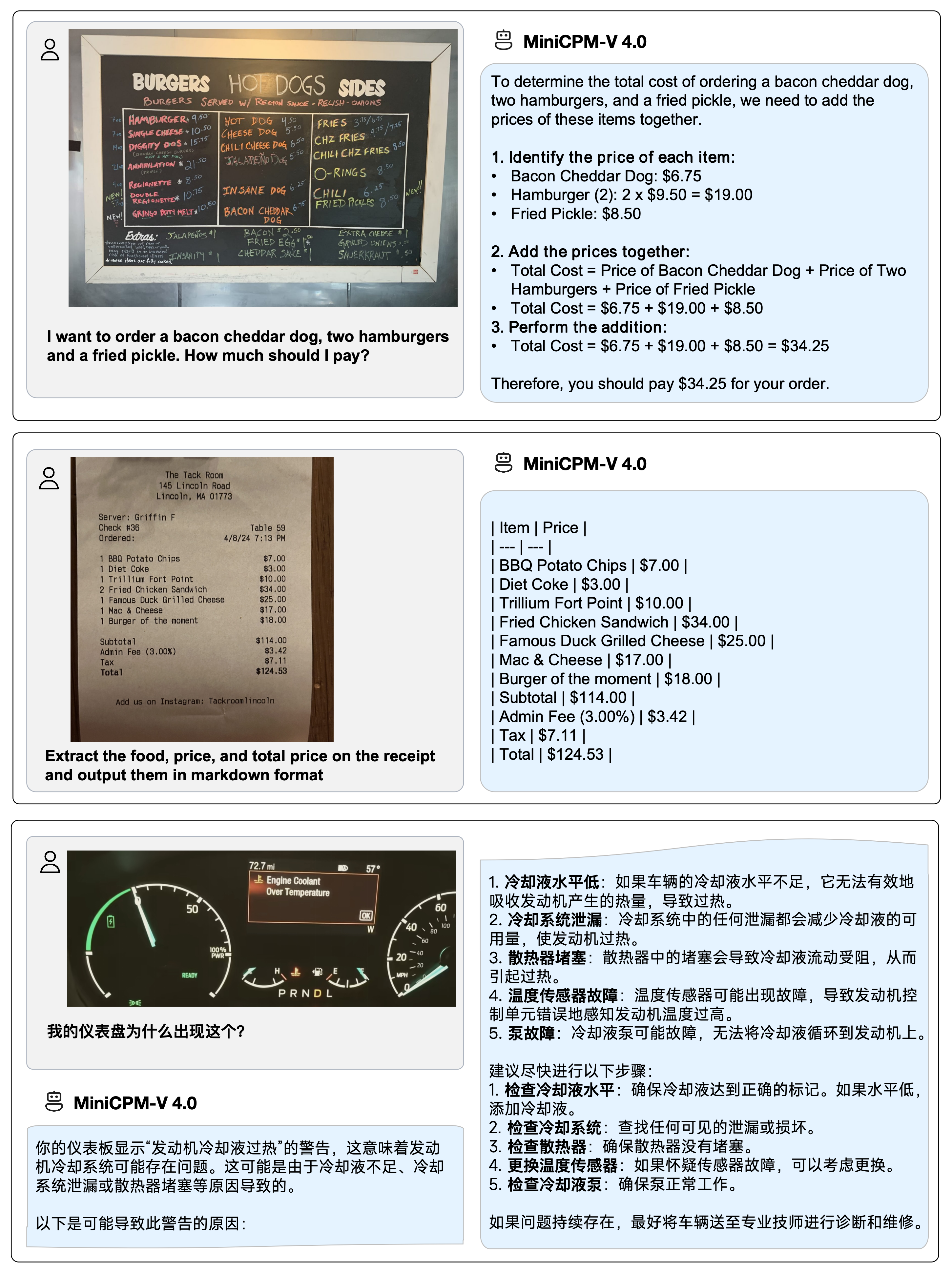
### Examples
math
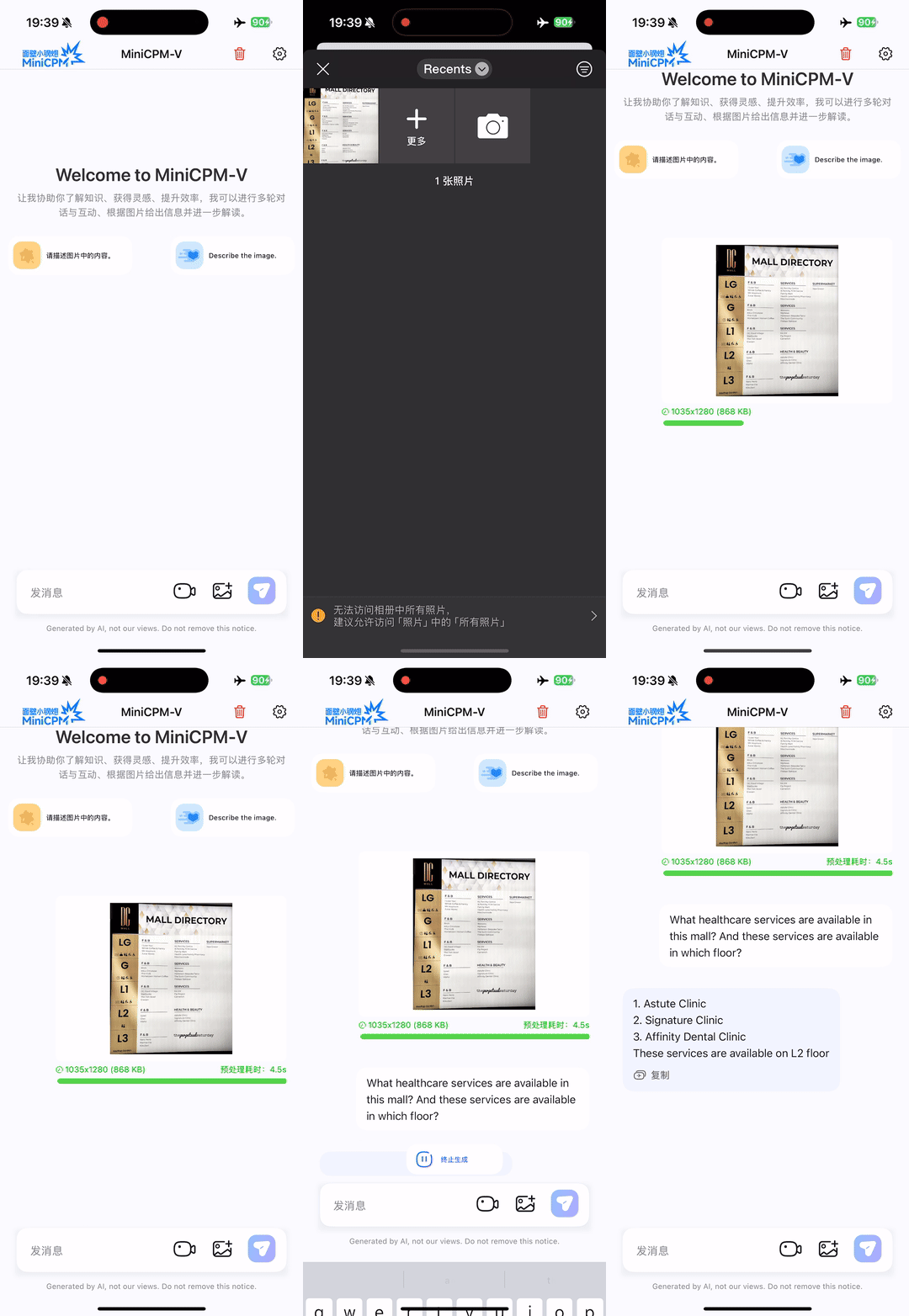
We deploy MiniCPM-V 4.0 on iPhone 16 Pro Max with [iOS demo](https://github.com/OpenSQZ/MiniCPM-V-CookBook/blob/main/demo/ios_demo/ios.md). The demo video is the raw screen recording without edition.


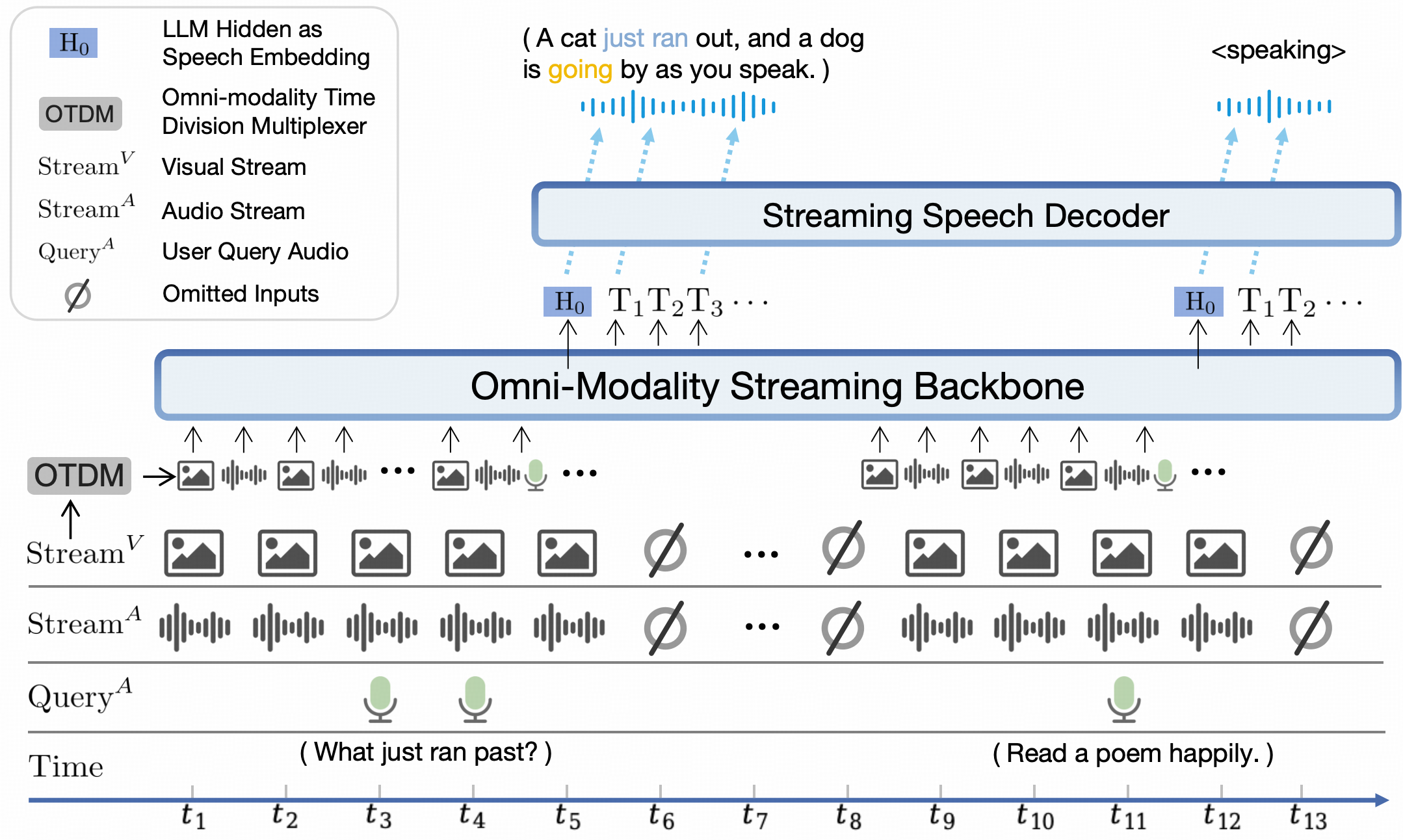
## MiniCPM-o 2.6 **MiniCPM-o 2.6** is the latest and most capable model in the MiniCPM-o series. The model is built in an end-to-end fashion based on SigLip-400M, Whisper-medium-300M, ChatTTS-200M, and Qwen2.5-7B with a total of 8B parameters. It exhibits a significant performance improvement over MiniCPM-V 2.6, and introduces new features for real-time speech conversation and multimodal live streaming. Notable features of MiniCPM-o 2.6 include: - 🔥 **Leading Visual Capability.** MiniCPM-o 2.6 achieves an average score of 70.2 on OpenCompass, a comprehensive evaluation of 8 popular benchmarks. **With only 8B parameters, it surpasses widely used proprietary models like GPT-4o-202405, Gemini 1.5 Pro, and Claude 3.5 Sonnet** for single image understanding. It also **outperforms GPT-4V and Claude 3.5 Sonnet** in multi-image and video understanding, and shows promising in-context learning capability. - 🎙 **State-of-the-art Speech Capability.** MiniCPM-o 2.6 supports **bilingual real-time speech conversation with configurable voices** in English and Chinese. It **outperforms GPT-4o-realtime on audio understanding tasks** such as ASR and STT translation, and shows **state-of-the-art performance on speech conversation in both semantic and acoustic evaluations in the open-source community**. It also allows for fun features such as emotion/speed/style control, end-to-end voice cloning, role play, etc. - 🎬 **Strong Multimodal Live Streaming Capability.** As a new feature, MiniCPM-o 2.6 can **accept continuous video and audio streams independent of user queries, and support real-time speech interaction**. It **outperforms GPT-4o-202408 and Claude 3.5 Sonnet and shows state-of-art performance in the open-source community on StreamingBench**, a comprehensive benchmark for real-time video understanding, omni-source (video & audio) understanding, and multimodal contextual understanding. - 💪 **Strong OCR Capability and Others.** Advancing popular visual capabilities from MiniCPM-V series, MiniCPM-o 2.6 can process images with any aspect ratio and up to 1.8 million pixels (e.g., 1344x1344). It achieves **state-of-the-art performance on OCRBench for models under 25B, surpassing proprietary models such as GPT-4o-202405**. Based on the the latest [RLAIF-V](https://github.com/RLHF-V/RLAIF-V/) and [VisCPM](https://github.com/OpenBMB/VisCPM) techniques, it features **trustworthy behaviors**, outperforming GPT-4o and Claude 3.5 Sonnet on MMHal-Bench, and supports **multilingual capabilities** on more than 30 languages. - 🚀 **Superior Efficiency.** In addition to its friendly size, MiniCPM-o 2.6 also shows **state-of-the-art token density** (i.e., the number of pixels encoded into each visual token). **It produces only 640 tokens when processing a 1.8M pixel image, which is 75% fewer than most models**. This directly improves the inference speed, first-token latency, memory usage, and power consumption. As a result, MiniCPM-o 2.6 can efficiently support **multimodal live streaming** on end-side devices such as iPads. - 💫 **Easy Usage.** MiniCPM-o 2.6 can be easily used in various ways: (1) [llama.cpp](https://github.com/OpenBMB/llama.cpp/blob/minicpm-omni/examples/llava/README-minicpmo2.6.md) support for efficient CPU inference on local devices, (2) [int4](https://huggingface.co/openbmb/MiniCPM-o-2_6-int4) and [GGUF](https://huggingface.co/openbmb/MiniCPM-o-2_6-gguf) format quantized models in 16 sizes, (3) [vLLM](#efficient-inference-with-llamacpp-ollama-vllm) support for high-throughput and memory-efficient inference, (4) fine-tuning on new domains and tasks with [LLaMA-Factory](./docs/llamafactory_train_and_infer.md), (5) quick [local WebUI demo](#chat-with-our-demo-on-gradio), and (6) online web demo on [server](https://minicpm-omni-webdemo-us.modelbest.cn/). **Model Architecture.** - **End-to-end Omni-modal Architecture.** Different modality encoders/decoders are connected and trained in an **end-to-end** fashion to fully exploit rich multimodal knowledge. The model is trained in a fully end-to-end manner with only CE loss. - **Omni-modal Live Streaming Mechanism.** (1) We change the offline modality encoder/decoders into online ones for **streaming inputs/outputs.** (2) We devise a **time-division multiplexing (TDM) mechanism** for omni-modality streaming processing in the LLM backbone. It divides parallel omni-modality streams into sequential info within small periodic time slices. - **Configurable Speech Modeling Design.** We devise a multimodal system prompt, including traditional text system prompt, and **a new audio system prompt to determine the assistant voice**. This enables flexible voice configurations in inference time, and also facilitates end-to-end voice cloning and description-based voice creation.
### Evaluation
Click to view visual understanding results. **Image Understanding**
Model Size Token Density+ OpenCompass OCRBench MathVista mini ChartQA MMVet MMStar MME MMB1.1 test AI2D MMMU val HallusionBench TextVQA val DocVQA test MathVerse mini MathVision MMHal Score
Proprietary
GPT-4o-20240513 - 1088 69.9 736 61.3 85.7 69.1 63.9 2328.7 82.2 84.6 69.2 55.0 - 92.8 50.2 30.4 3.6
Claude3.5-Sonnet - 750 67.9 788 61.6 90.8 66.0 62.2 1920.0 78.5 80.2 65.9 49.9 - 95.2 - - 3.4
Gemini 1.5 Pro - - 64.4 754 57.7 81.3 64.0 59.1 2110.6 73.9 79.1 60.6 45.6 73.5 86.5 - 19.2 -
GPT-4o-mini-20240718 - 1088 64.1 785 52.4 - 66.9 54.8 2003.4 76.0 77.8 60.0 46.1 - - - - 3.3
Open Source
Cambrian-34B 34B 1820 58.3 591 50.3 75.6 53.2 54.2 2049.9 77.8 79.5 50.4 41.6 76.7 75.5 - - -
GLM-4V-9B 13B 784 59.1 776 51.1 - 58.0 54.8 2018.8 67.9 71.2 46.9 45.0 - - - - -
Pixtral-12B 12B 256 61.0 685 56.9 81.8 58.5 54.5 - 72.7 79.0 51.1 47.0 75.7 90.7 - - -
VITA-1.5 8B 784 63.3 741 66.2 - 52.7 60.2 2328.1 76.8 79.2 52.6 44.6 - - - - -
DeepSeek-VL2-27B (4B) 27B 672 66.4 809 63.9 86.0 60.0 61.9 2253.0 81.2 83.8 54.0 45.3 84.2 93.3 - - 3.0
Qwen2-VL-7B 8B 784 67.1 866 58.2 83.0 62.0 60.7 2326.0 81.8 83.0 54.1 50.6 84.3 94.5 31.9 16.3 3.2
LLaVA-OneVision-72B 72B 182 68.1 741 67.5 83.7 60.6 65.8 2261.0 85.0 85.6 56.8 49.0 80.5 91.3 39.1 - 3.5
InternVL2.5-8B 8B 706 68.3 822 64.4 84.8 62.8 62.8 2344.0 83.6 84.5 56.0 50.1 79.1 93.0 39.5 19.7 3.4
MiniCPM-V 2.6 8B 2822 65.2 852* 60.6 79.4 60.0 57.5 2348.4* 78.0 82.1 49.8* 48.1* 80.1 90.8 25.7 18.3 3.6
MiniCPM-o 2.6 8B 2822 70.2 897* 71.9* 86.9* 67.5 64.0 2372.0* 80.5 85.8 50.4* 51.9 82.0 93.5 41.4* 23.1* 3.8
* We evaluate this benchmark using chain-of-thought prompting. Specifically, for MME, we used this technique only for the Cognition set. + Token Density: number of pixels encoded into each visual token at maximum resolution, i.e., # pixels at maximum resolution / # visual tokens. Note: For proprietary models, we calculate token density based on the image encoding charging strategy defined in the official API documentation, which provides an upper-bound estimation. **Multi-image and Video Understanding**
Model Size BLINK val Mantis Eval MIRB Video-MME (wo / w subs)
Proprietary
GPT-4o-20240513 - 68.0 - - 71.9/77.2
GPT4V - 54.6 62.7 53.1 59.9/63.3
Open-source
VITA-1.5 8B 45.0 - - 56.1/58.7
LLaVA-NeXT-Interleave 14B 14B 52.6 66.4 30.2 -
LLaVA-OneVision-72B 72B 55.4 77.6 - 66.2/69.5
MANTIS 8B 8B 49.1 59.5 34.8 -
Qwen2-VL-7B 8B 53.2 69.6* 67.6* 63.3/69.0
InternVL2.5-8B 8B 54.8 67.7 52.5 64.2/66.9
MiniCPM-V 2.6 8B 53.0 69.1 53.8 60.9/63.6
MiniCPM-o 2.6 8B 56.7 71.9 58.6 63.9/67.9
* We evaluate officially released checkpoints by ourselves.
Click to view audio understanding and speech conversation results. **Audio Understanding**
Task Size ASR (zh) ASR (en) AST Emotion
Metric CER↓ WER↓ BLEU↑ ACC↑
Dataset AISHELL-1 Fleurs zh WenetSpeech test-net LibriSpeech test-clean GigaSpeech TED-LIUM CoVoST en2zh CoVoST zh2en MELD emotion
Proprietary
GPT-4o-Realtime - 7.3* 5.4* 28.9* 2.6* 12.9* 4.8* 37.1* 15.7* 33.2*
Gemini 1.5 Pro - 4.5* 5.9* 14.3* 2.9* 10.6* 3.0* 47.3* 22.6* 48.4*
Open-Source
Qwen2-Audio-7B 8B - 7.5 - 1.6 - - 45.2 24.4 55.3
Qwen2-Audio-7B-Instruct 8B 2.6* 6.9* 10.3* 3.1* 9.7* 5.9* 39.5* 22.9* 17.4*
VITA-1.5 8B 2.16 - 8.4 3.4 - - - - -
GLM-4-Voice-Base 9B 2.5 - - 2.8 - - - -
MiniCPM-o 2.6 8B 1.6 4.4 6.9 1.7 8.7 3.0 48.2 27.2 52.4
* We evaluate officially released checkpoints by ourselves.

**Speech Generation**
Task Size SpeechQA
Metric ACC↑ G-Eval (10 point)↑ Semantic ELO score↑ Acoustic ELO score↑ Overall ELO score↑ UTMOS↑ ASR-WER↓
Dataset Speech Llama Q. Speech Web Q. Speech Trivia QA Speech AlpacaEval AudioArena
Proprietary
GPT-4o-Realtime 71.7 51.6 69.7 7.4 1157 1203 1200 4.2 2.3
Open-Source
GLM-4-Voice 9B 50.0 32.0 36.4 5.1 999 1147 1035 4.1 11.7
Llama-Omni 8B 45.3 22.9 10.7 3.9 960 878 897 3.2 24.3
VITA-1.5 8B 46.7 28.1 23.3 2.0 - - - - -
Moshi 7B 43.7 23.8 16.7 2.4 871 808 875 2.8 8.2
Mini-Omni 1B 22.0 12.8 6.9 2.5 926 803 865 3.4 10.0
MiniCPM-o 2.6 8B 61.0 40.0 40.2 5.1 1088 1163 1131 4.2 9.8
All results are from AudioEvals, and the evaluation methods along with further details can be found in AudioEvals.

**End-to-end Voice Cloning**
Task Voice cloning
Metric SIMO↑ SIMO↑
Dataset Seed-TTS test-zh Seed-TTS test-en
F5-TTS 76 67
CosyVoice 75 64
FireRedTTS 63 46
MiniCPM-o 2.6 57 47
Click to view multimodal live streaming results. **Multimodal Live Streaming**: results on StreamingBench
Model Size Real-Time Video Understanding Omni-Source Understanding Contextual Understanding Overall
Proprietary
Gemini 1.5 Pro - 77.4 67.8 51.1 70.3
GPT-4o-202408 - 74.5 51.0 48.0 64.1
Claude-3.5-Sonnet - 74.0 41.4 37.8 59.7
Open-source
VILA-1.5 8B 61.5 37.5 26.7 49.5
LongVA 7B 63.1 35.9 30.2 50.7
LLaVA-Next-Video-34B 34B 69.8 41.7 34.3 56.7
Qwen2-VL-7B 8B 71.2 40.7 33.1 57.0
InternVL2-8B 8B 70.1 42.7 34.1 57.0
VITA-1.5 8B 70.9 40.8 35.8 57.4
LLaVA-OneVision-7B 8B 74.3 40.8 31.0 58.4
InternLM-XC2.5-OL-7B 8B 75.4 46.2 33.6 60.8
MiniCPM-V 2.6 8B 72.4 40.2 33.4 57.7
MiniCPM-o 2.6 8B 79.9 53.4 38.5 66.0
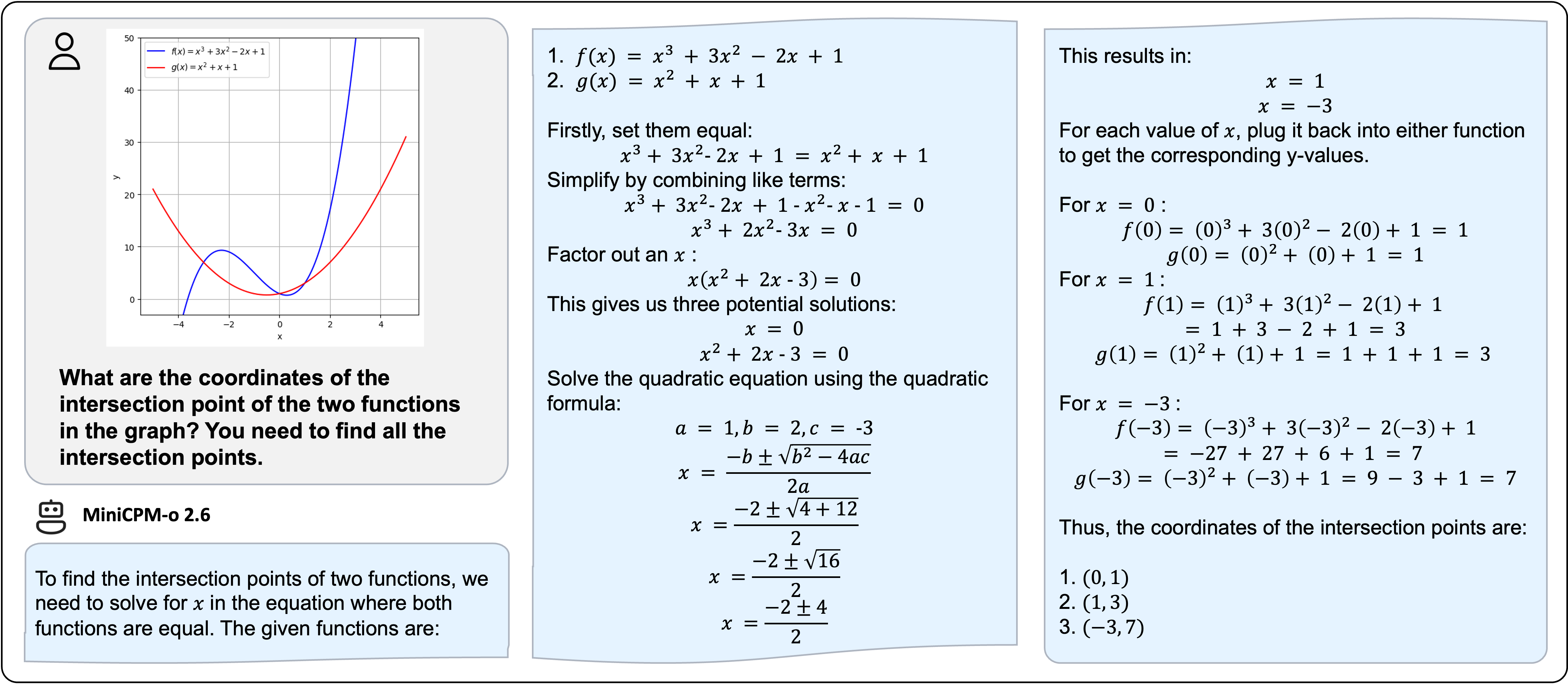
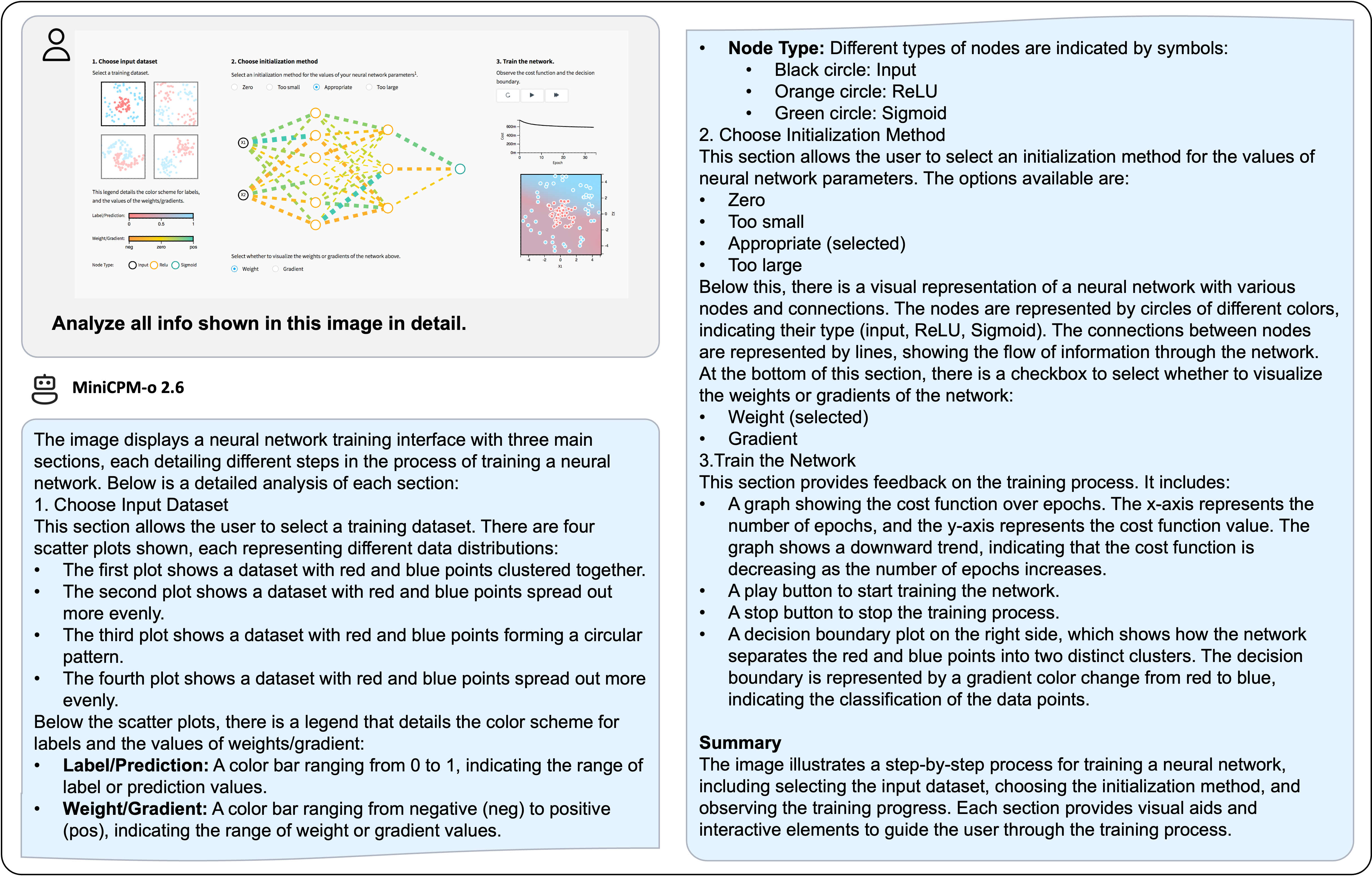
### Examples We deploy MiniCPM-o 2.6 on end devices. The demo video is the raw-speed recording on an iPad Pro and a Web demo.

math diagram bike
## MiniCPM-V 2.6
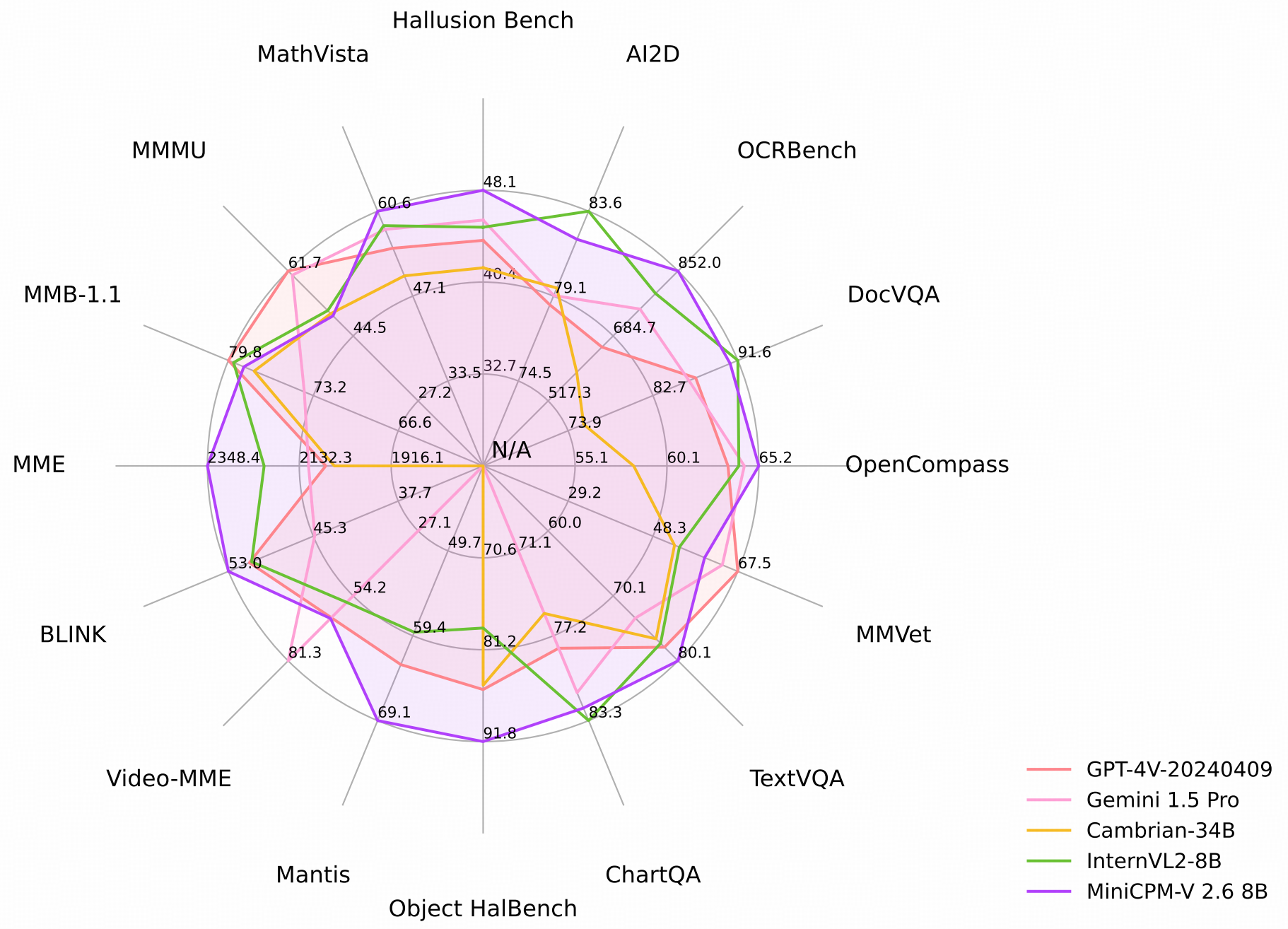
Click to view more details of MiniCPM-V 2.6 **MiniCPM-V 2.6** is the latest and most capable model in the MiniCPM-V series. The model is built on SigLip-400M and Qwen2-7B with a total of 8B parameters. It exhibits a significant performance improvement over MiniCPM-Llama3-V 2.5, and introduces new features for multi-image and video understanding. Notable features of MiniCPM-V 2.6 include: - 🔥 **Leading Performance.** MiniCPM-V 2.6 achieves an average score of 65.2 on the latest version of OpenCompass, a comprehensive evaluation over 8 popular benchmarks. **With only 8B parameters, it surpasses widely used proprietary models like GPT-4o mini, GPT-4V, Gemini 1.5 Pro, and Claude 3.5 Sonnet** for single image understanding. - 🖼️ **Multi Image Understanding and In-context Learning.** MiniCPM-V 2.6 can also perform **conversation and reasoning over multiple images**. It achieves **state-of-the-art performance** on popular multi-image benchmarks such as Mantis-Eval, BLINK, Mathverse mv and Sciverse mv, and also shows promising in-context learning capability. - 🎬 **Video Understanding.** MiniCPM-V 2.6 can also **accept video inputs**, performing conversation and providing dense captions for spatial-temporal information. It outperforms **GPT-4V, Claude 3.5 Sonnet and LLaVA-NeXT-Video-34B** on Video-MME with/without subtitles. - 💪 **Strong OCR Capability and Others.** MiniCPM-V 2.6 can process images with any aspect ratio and up to 1.8 million pixels (e.g., 1344x1344). It achieves **state-of-the-art performance on OCRBench, surpassing proprietary models such as GPT-4o, GPT-4V, and Gemini 1.5 Pro**. Based on the the latest [RLAIF-V](https://github.com/RLHF-V/RLAIF-V/) and [VisCPM](https://github.com/OpenBMB/VisCPM) techniques, it features **trustworthy behaviors**, with significantly lower hallucination rates than GPT-4o and GPT-4V on Object HalBench, and supports **multilingual capabilities** on English, Chinese, German, French, Italian, Korean, etc. - 🚀 **Superior Efficiency.** In addition to its friendly size, MiniCPM-V 2.6 also shows **state-of-the-art token density** (i.e., number of pixels encoded into each visual token). **It produces only 640 tokens when processing a 1.8M pixel image, which is 75% fewer than most models**. This directly improves the inference speed, first-token latency, memory usage, and power consumption. As a result, MiniCPM-V 2.6 can efficiently support **real-time video understanding** on end-side devices such as iPad. - 💫 **Easy Usage.** MiniCPM-V 2.6 can be easily used in various ways: (1) [llama.cpp](https://github.com/OpenBMB/llama.cpp/blob/minicpmv-main/examples/llava/README-minicpmv2.6.md) and [Ollama](https://github.com/OpenBMB/ollama/blob/minicpm-v2.6/examples/minicpm-v2.6/README.md) support for efficient CPU inference on local devices, (2) [int4](https://huggingface.co/openbmb/MiniCPM-V-2_6-int4) and [GGUF](https://huggingface.co/openbmb/MiniCPM-V-2_6-gguf) format quantized models in 16 sizes, (3) [vLLM](#inference-with-vllm) support for high-throughput and memory-efficient inference, (4) fine-tuning on new domains and tasks, (5) quick local WebUI demo setup with [Gradio](#chat-with-our-demo-on-gradio), and (6) online web [demo](http://120.92.209.146:8887/). ### Evaluation
Click to view single image results on OpenCompass, MME, MMVet, OCRBench, MMMU, MathVista, MMB, AI2D, TextVQA, DocVQA, HallusionBench, Object HalBench.
Model Size Token Density+ OpenCompass MME MMVet OCRBench MMMU val MathVista mini MMB1.1 test AI2D TextVQA val DocVQA test HallusionBench Object HalBench
Proprietary
GPT-4o - 1088 69.9 2328.7 69.1 736 69.2 61.3 82.2 84.6 - 92.8 55.0 17.6
Claude 3.5 Sonnet - 750 67.9 1920.0 66.0 788 65.9 61.6 78.5 80.2 - 95.2 49.9 13.8
Gemini 1.5 Pro - - 64.4 2110.6 64.0 754 60.6 57.7 73.9 79.1 73.5 86.5 45.6 -
GPT-4o mini - 1088 64.1 2003.4 66.9 785 60.0 52.4 76.0 77.8 - - 46.1 12.4
GPT-4V - 1088 63.5 2070.2 67.5 656 61.7 54.7 79.8 78.6 78.0 87.2 43.9 14.2
Step-1V - - 59.5 2206.4 63.3 625 49.9 44.8 78.0 79.2 71.6 - 48.4 -
Qwen-VL-Max - 784 58.3 2281.7 61.8 684 52.0 43.4 74.6 75.7 79.5 93.1 41.2 13.4
Open-source
LLaVA-NeXT-Yi-34B 34B 157 55.0 2006.5 50.7 574 48.8 40.4 77.8 78.9 69.3 - 34.8 12.6
Mini-Gemini-HD-34B 34B 157 - 2141.0 59.3 518 48.0 43.3 - 80.5 74.1 78.9 - -
Cambrian-34B 34B 1820 58.3 2049.9 53.2 591 50.4 50.3 77.8 79.5 76.7 75.5 41.6 14.7
GLM-4V-9B 13B 784 59.1 2018.8 58.0 776 46.9 51.1 67.9 71.2 - - 45.0 -
InternVL2-8B 8B 706 64.1 2215.1 54.3 794 51.2 58.3 79.4 83.6 77.4 91.6 45.0 21.3
MiniCPM-Llama-V 2.5 8B 1882 58.8 2024.6 52.8 725 45.8 54.3 72.0 78.4 76.6 84.8 42.4 10.3
MiniCPM-V 2.6 8B 2822 65.2 2348.4* 60.0 852* 49.8* 60.6 78.0 82.1 80.1 90.8 48.1* 8.2
* We evaluate this benchmark using chain-of-thought prompting. Specifically, for MME, we used this technique only for the Cognition set. + Token Density: number of pixels encoded into each visual token at maximum resolution, i.e., # pixels at maximum resolution / # visual tokens. Note: For proprietary models, we calculate token density based on the image encoding charging strategy defined in the official API documentation, which provides an upper-bound estimation.
Click to view multi-image results on Mantis Eval, BLINK, Mathverse mv, Sciverse mv, MIRB.
Model Size Mantis Eval BLINK val Mathverse mv Sciverse mv MIRB
Proprietary
GPT-4V - 62.7 54.6 60.3 66.9 53.1
LLaVA-NeXT-Interleave-14B 14B 66.4 52.6 32.7 30.2 -
Open-source
Emu2-Chat 37B 37.8 36.2 - 27.2 -
CogVLM 17B 45.2 41.1 - - -
VPG-C 7B 52.4 43.1 24.3 23.1 -
VILA 8B 8B 51.2 39.3 - 36.5 -
InternLM-XComposer-2.5 8B 53.1* 48.9 32.1* - 42.5
InternVL2-8B 8B 59.0* 50.9 30.5* 34.4* 56.9*
MiniCPM-V 2.6 8B 69.1 53.0 84.9 74.9 53.8
* We evaluate the officially released checkpoint by ourselves.
Click to view video results on Video-MME and Video-ChatGPT.
Model Size Video-MME Video-ChatGPT
w/o subs w subs Correctness Detail Context Temporal Consistency
Proprietary
Claude 3.5 Sonnet - 60.0 62.9 - - - - -
GPT-4V - 59.9 63.3 - - - - -
Open-source
LLaVA-NeXT-7B 7B - - 3.39 3.29 3.92 2.60 3.12
LLaVA-NeXT-34B 34B - - 3.29 3.23 3.83 2.51 3.47
CogVLM2-Video 12B - - 3.49 3.46 3.23 2.98 3.64
LongVA 7B 52.4 54.3 3.05 3.09 3.77 2.44 3.64
InternVL2-8B 8B 54.0 56.9 - - - - -
InternLM-XComposer-2.5 8B 55.8 - - - - - -
LLaVA-NeXT-Video 32B 60.2 63.0 3.48 3.37 3.95 2.64 3.28
MiniCPM-V 2.6 8B 60.9 63.6 3.59 3.28 3.93 2.73 3.62
Click to view few-shot results on TextVQA, VizWiz, VQAv2, OK-VQA.
Model Size Shot TextVQA val VizWiz test-dev VQAv2 test-dev OK-VQA val
Flamingo 80B 0* 35.0 31.6 56.3 40.6
4 36.5 39.6 63.1 57.4
8 37.3 44.8 65.6 57.5
IDEFICS 80B 0* 30.9 36.0 60.0 45.2
4 34.3 40.4 63.6 52.4
8 35.7 46.1 64.8 55.1
OmniCorpus 7B 0* 43.0 49.8 63.2 45.5
4 45.4 51.3 64.5 46.5
8 45.6 52.2 64.7 46.6
Emu2 37B 0 26.4 40.4 33.5 26.7
4 48.2 54.6 67.0 53.2
8 49.3 54.7 67.8 54.1
MM1 30B 0 26.2 40.4 48.9 26.7
8 49.3 54.7 70.9 54.1
MiniCPM-V 2.6+ 8B 0 43.9 33.8 45.4 23.9
4 63.6 60.5 65.5 50.1
8 64.6 63.4 68.2 51.4
* denotes zero image shot and two additional text shots following Flamingo. + We evaluate the pretraining ckpt without SFT.
### Examples
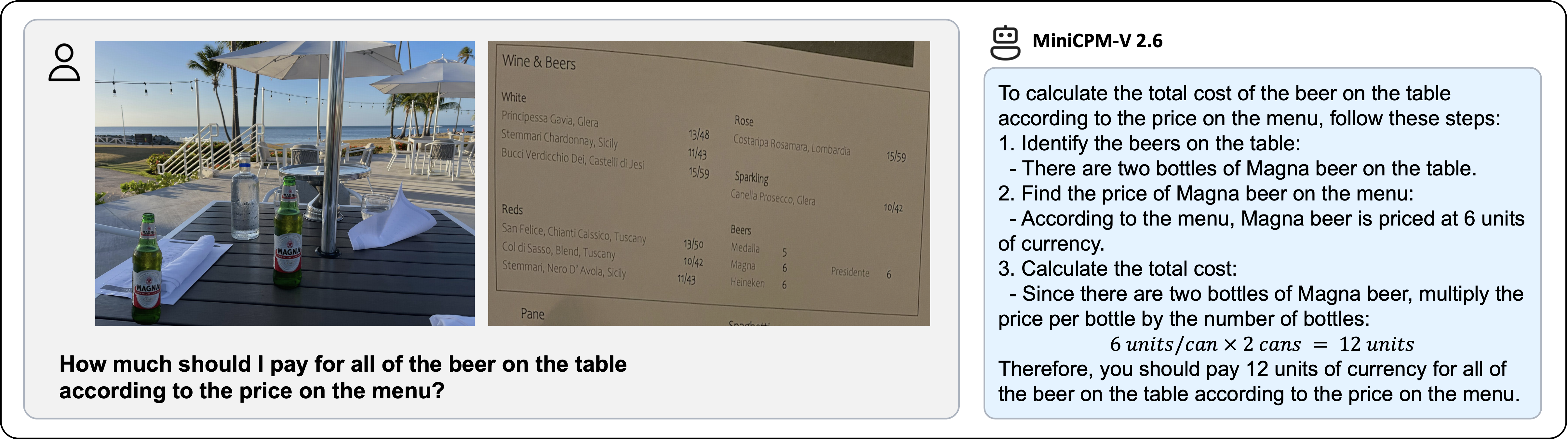
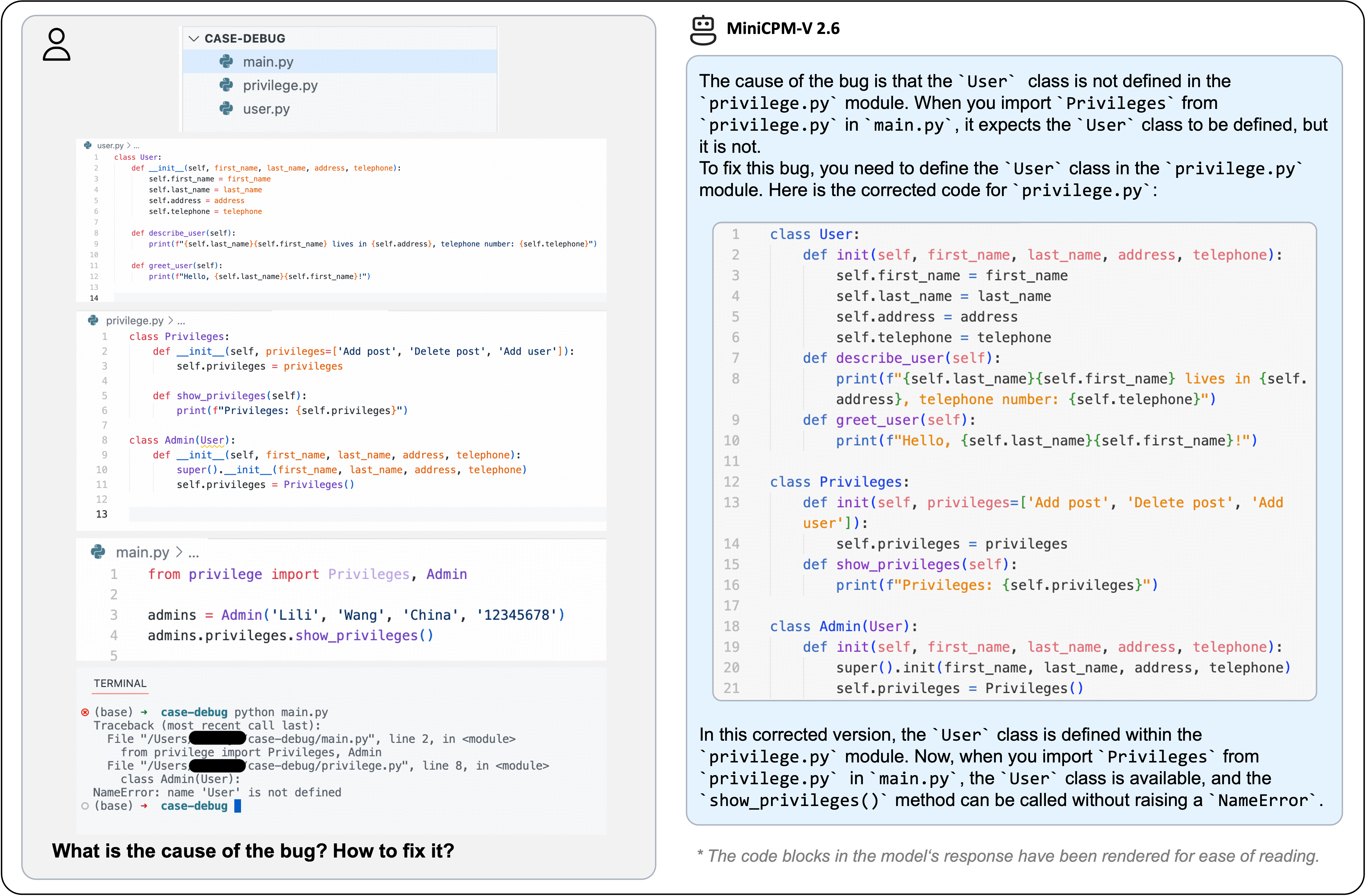
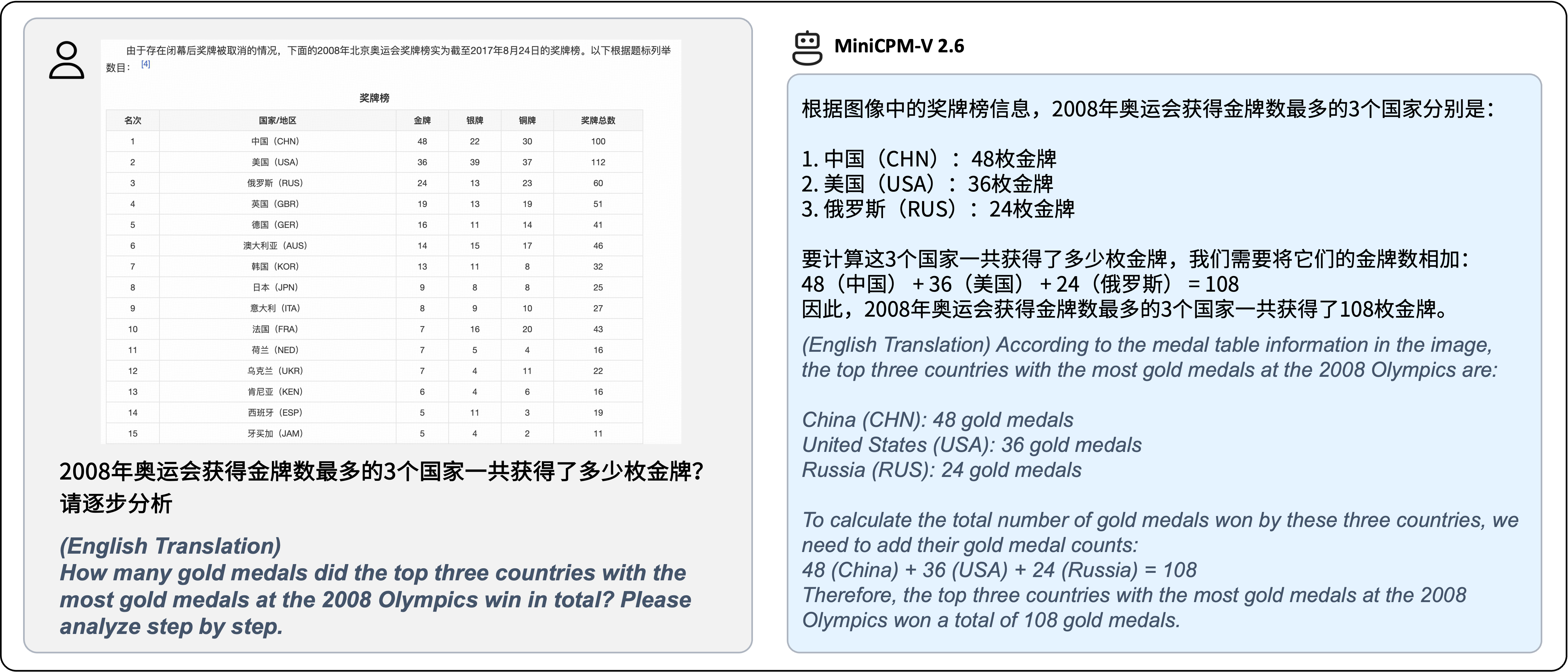
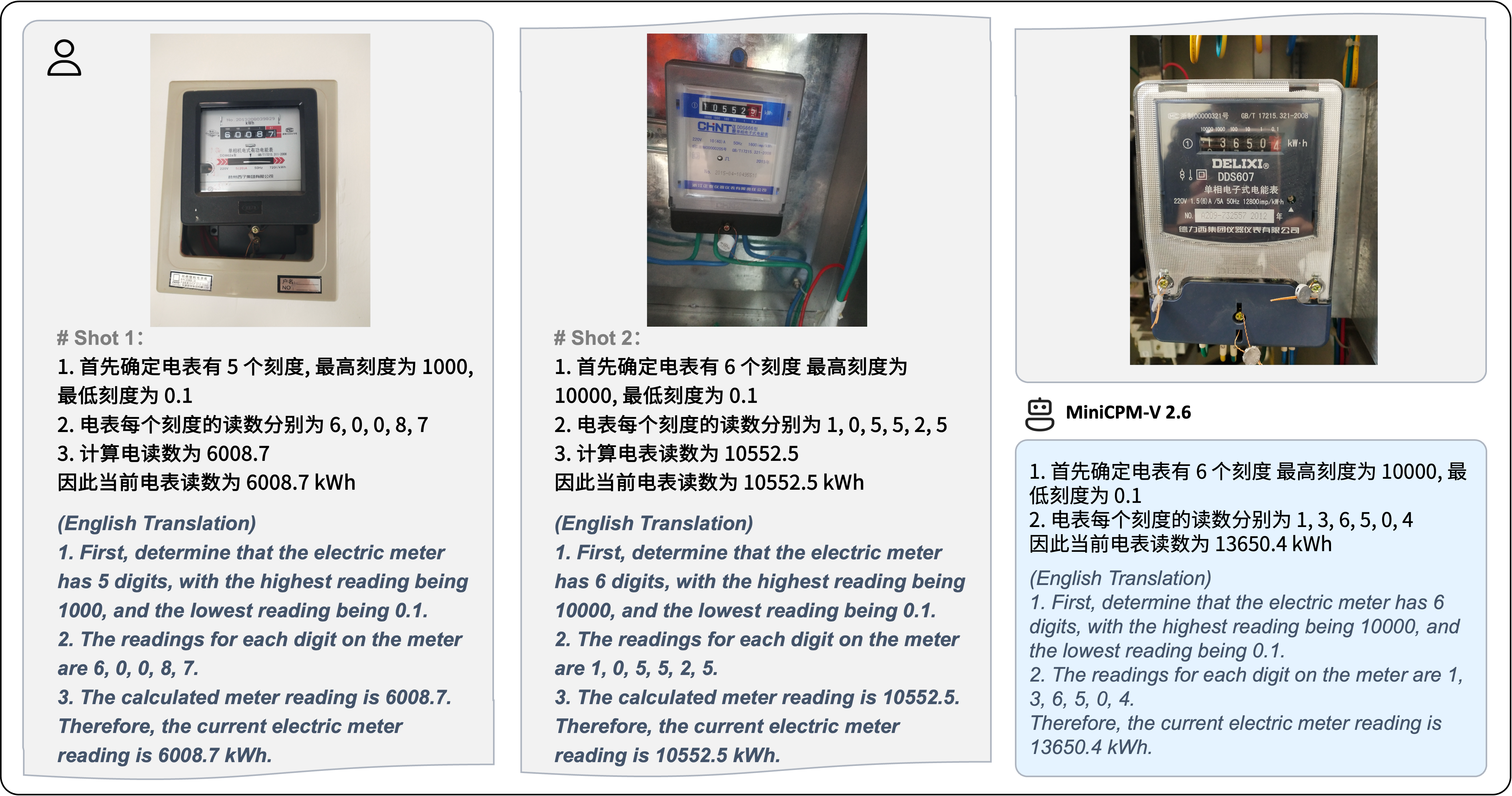
Bike Menu Code Mem medal
Click to view more cases.
elec Menu
We deploy MiniCPM-V 2.6 on end devices. The demo video is the raw screen recording on a iPad Pro without edition.


## Legacy Models | Model | Introduction and Guidance | |:----------------------|:-------------------:| | MiniCPM-Llama3-V 2.5 | [Document](./docs/minicpm_llama3_v2dot5.md) | | MiniCPM-V 2.0 | [Document](./docs/minicpm_v2.md) | | MiniCPM-V 1.0 | [Document](./docs/minicpm_v1.md) | | OmniLMM-12B | [Document](././docs/omnilmm_en.md) | ## MiniCPM-V & o Cookbook Discover comprehensive, ready-to-deploy solutions for the MiniCPM-V and MiniCPM-o model series in our structured [cookbook](https://github.com/OpenSQZ/MiniCPM-V-CookBook), which empowers developers to rapidly implement multimodal AI applications with integrated vision, speech, and live-streaming capabilities. Key features include: **Easy Usage Documentation** Our comprehensive [documentation website](https://minicpm-o.readthedocs.io/en/latest/index.html) presents every recipe in a clear, well-organized manner. All features are displayed at a glance, making it easy for you to quickly find exactly what you need. **Broad User Spectrum** We support a wide range of users, from individuals to enterprises and researchers. * **Individuals**: Enjoy effortless inference using [Ollama](https://github.com/OpenSQZ/MiniCPM-V-CookBook/blob/main/deployment/ollama/minicpm-v4_ollama.md) and [Llama.cpp](https://github.com/OpenSQZ/MiniCPM-V-CookBook/blob/main/deployment/llama.cpp/minicpm-v4_llamacpp.md) with minimal setup. * **Enterprises**: Achieve high-throughput, scalable performance with [vLLM](https://github.com/OpenSQZ/MiniCPM-V-CookBook/blob/main/deployment/vllm/minicpm-v4_vllm.md) and [SGLang](https://github.com/OpenSQZ/MiniCPM-V-CookBook/blob/main/deployment/sglang/MiniCPM-v4_sglang.md). * **Researchers**: Leverage advanced frameworks including [Transformers](https://github.com/OpenSQZ/MiniCPM-V-CookBook/blob/main/finetune/finetune_full.md), [LLaMA-Factory](https://github.com/OpenSQZ/MiniCPM-V-CookBook/blob/main/finetune/finetune_llamafactory.md), [SWIFT](https://github.com/OpenSQZ/MiniCPM-V-CookBook/blob/main/finetune/swift.md), and [Align-anything](https://github.com/OpenSQZ/MiniCPM-V-CookBook/blob/main/finetune/align_anything.md) to enable flexible model development and cutting-edge experimentation. **Versatile Deployment Scenarios** Our ecosystem delivers optimal solution for a variety of hardware environments and deployment demands. * **Web demo**: Launch interactive multimodal AI web demo with [FastAPI](https://github.com/OpenSQZ/MiniCPM-V-CookBook/blob/main/demo/README.md). * **Quantized deployment**: Maximize efficiency and minimize resource consumption using [GGUF](https://github.com/OpenSQZ/MiniCPM-V-CookBook/blob/main/quantization/gguf/minicpm-v4_gguf_quantize.md) and [BNB](https://github.com/OpenSQZ/MiniCPM-V-CookBook/blob/main/quantization/bnb/minicpm-v4_bnb_quantize.md). * **End devices**: Bring powerful AI experiences to [iPhone and iPad](https://github.com/OpenSQZ/MiniCPM-V-CookBook/blob/main/demo/ios_demo/ios.md), supporting offline and privacy-sensitive applications. ## Chat with Our Demo on Gradio 🤗 We provide online and local demos powered by Hugging Face Gradio , the most popular model deployment framework nowadays. It supports streaming outputs, progress bars, queuing, alerts, and other useful features. ### Online Demo Click here to try out the online demo of [MiniCPM-o 2.6](https://minicpm-omni-webdemo-us.modelbest.cn/) | [MiniCPM-V 2.6](http://120.92.209.146:8887/) | [MiniCPM-Llama3-V 2.5](https://huggingface.co/spaces/openbmb/MiniCPM-Llama3-V-2_5) | [MiniCPM-V 2.0](https://huggingface.co/spaces/openbmb/MiniCPM-V-2). ### Local WebUI Demo You can easily build your own local WebUI demo using the following commands. Please ensure that `transformers==4.44.2` is installed, as other versions may have compatibility issues. If you are using an older version of PyTorch, you might encounter this issue `"weight_norm_fwd_first_dim_kernel" not implemented for 'BFloat16'`, Please add `self.minicpmo_model.tts.float()` during the model initialization. **For real-time voice/video call demo:** 1. launch model server: ```shell pip install -r requirements_o2.6.txt python web_demos/minicpm-o_2.6/model_server.py ``` 2. launch web server: ```shell # Make sure Node and PNPM is installed. sudo apt-get update sudo apt-get install nodejs npm npm install -g pnpm cd web_demos/minicpm-o_2.6/web_server # create ssl cert for https, https is required to request camera and microphone permissions. bash ./make_ssl_cert.sh # output key.pem and cert.pem pnpm install # install requirements pnpm run dev # start server ``` Open `https://localhost:8088/` in browser and enjoy the real-time voice/video call. **For chatbot demo:** ```shell pip install -r requirements_o2.6.txt python web_demos/minicpm-o_2.6/chatbot_web_demo_o2.6.py ``` Open `http://localhost:8000/` in browser and enjoy the vision mode chatbot. ## Inference ### Model Zoo | Model | Device | Memory |          Description | Download | |:-----------|:--:|:-----------:|:-------------------|:---------------:| | MiniCPM-V 4.0| GPU | 9 GB | The latest version, strong end-side multimodal performance for single image, multi-image and video understanding. | [🤗](https://huggingface.co/openbmb/MiniCPM-V-4)    [](https://modelscope.cn/models/OpenBMB/MiniCPM-V-4) | | MiniCPM-V 4.0 gguf | CPU | 4 GB | The gguf version, lower memory usage and faster inference. | [🤗](https://huggingface.co/openbmb/MiniCPM-V-4-gguf)    [](https://modelscope.cn/models/OpenBMB/MiniCPM-V-4-gguf) | | MiniCPM-V 4.0 int4 | GPU | 5 GB | The int4 quantized version, lower GPU memory usage. | [🤗](https://huggingface.co/openbmb/MiniCPM-V-4-int4)    [](https://modelscope.cn/models/OpenBMB/MiniCPM-V-4-int4) | | MiniCPM-V 4.0 AWQ | GPU | 5 GB | The int4 quantized version, lower GPU memory usage. | [🤗](https://huggingface.co/openbmb/MiniCPM-V-4-AWQ)    [](https://modelscope.cn/models/OpenBMB/MiniCPM-V-4-AWQ) | | MiniCPM-o 2.6| GPU | 18 GB | The latest version, achieving GPT-4o level performance for vision, speech and multimodal live streaming on end-side devices. | [🤗](https://huggingface.co/openbmb/MiniCPM-o-2_6)    [](https://modelscope.cn/models/OpenBMB/MiniCPM-o-2_6) | | MiniCPM-o 2.6 gguf | CPU | 8 GB | The gguf version, lower memory usage and faster inference. | [🤗](https://huggingface.co/openbmb/MiniCPM-o-2_6-gguf)    [](https://modelscope.cn/models/OpenBMB/MiniCPM-o-2_6-gguf) | | MiniCPM-o 2.6 int4 | GPU | 9 GB | The int4 quantized version, lower GPU memory usage. | [🤗](https://huggingface.co/openbmb/MiniCPM-o-2_6-int4)    [](https://modelscope.cn/models/OpenBMB/MiniCPM-o-2_6-int4) | | MiniCPM-V 2.6| GPU | 17 GB | Strong end-side multimodal performance for single image, multi-image and video understanding. | [🤗](https://huggingface.co/openbmb/MiniCPM-V-2_6)    [](https://modelscope.cn/models/OpenBMB/MiniCPM-V-2_6) | | MiniCPM-V 2.6 gguf | CPU | 6 GB | The gguf version, lower memory usage and faster inference. | [🤗](https://huggingface.co/openbmb/MiniCPM-V-2_6-gguf)    [](https://modelscope.cn/models/OpenBMB/MiniCPM-V-2_6-gguf) | | MiniCPM-V 2.6 int4 | GPU | 7 GB | The int4 quantized version, lower GPU memory usage. | [🤗](https://huggingface.co/openbmb/MiniCPM-V-2_6-int4)    [](https://modelscope.cn/models/OpenBMB/MiniCPM-V-2_6-int4) | ### Multi-turn Conversation Please ensure that `transformers==4.44.2` is installed, as other versions may have compatibility issues. We are investigating this issue. ```shell pip install -r requirements_o2.6.txt ``` Please refer to the following codes to run.

```python import torch from PIL import Image from transformers import AutoModel, AutoTokenizer torch.manual_seed(100) model = AutoModel.from_pretrained('openbmb/MiniCPM-V-4', trust_remote_code=True, # or openbmb/MiniCPM-o-2_6 attn_implementation='sdpa', torch_dtype=torch.bfloat16) # sdpa or flash_attention_2, no eager model = model.eval().cuda() tokenizer = AutoTokenizer.from_pretrained('openbmb/MiniCPM-V-4', trust_remote_code=True) # or openbmb/MiniCPM-o-2_6 image = Image.open('./assets/minicpmo2_6/show_demo.jpg').convert('RGB') # First round chat question = "What is the landform in the picture?" msgs = [{'role': 'user', 'content': [image, question]}] answer = model.chat( msgs=msgs, tokenizer=tokenizer ) print(answer) # Second round chat, pass history context of multi-turn conversation msgs.append({"role": "assistant", "content": [answer]}) msgs.append({"role": "user", "content": ["What should I pay attention to when traveling here?"]}) answer = model.chat( msgs=msgs, tokenizer=tokenizer ) print(answer) ``` You will get the following output: ``` "The landform in the picture is karst topography, characterized by its unique and striking limestone formations that rise dramatically from the surrounding landscape." "When traveling to this picturesque location, you should pay attention to the weather conditions as they can change rapidly in such areas. It's also important to respect local ecosystems and wildlife by staying on designated paths and not disturbing natural habitats. Additionally, bringing appropriate gear for photography is advisable due to the stunning reflections and lighting during sunrise or sunset." ``` #### Chat with Multiple Images
Click to view Python code running MiniCPM-V-4 with multiple images input. ```python import torch from PIL import Image from transformers import AutoModel, AutoTokenizer model = AutoModel.from_pretrained('openbmb/MiniCPM-V-4', trust_remote_code=True, # or openbmb/MiniCPM-o-2_6 attn_implementation='sdpa', torch_dtype=torch.bfloat16) # sdpa or flash_attention_2, no eager model = model.eval().cuda() tokenizer = AutoTokenizer.from_pretrained('openbmb/MiniCPM-V-4', trust_remote_code=True) # or openbmb/MiniCPM-o-2_6 image1 = Image.open('image1.jpg').convert('RGB') image2 = Image.open('image2.jpg').convert('RGB') question = 'Compare image 1 and image 2, tell me about the differences between image 1 and image 2.' msgs = [{'role': 'user', 'content': [image1, image2, question]}] answer = model.chat( msgs=msgs, tokenizer=tokenizer ) print(answer) ```
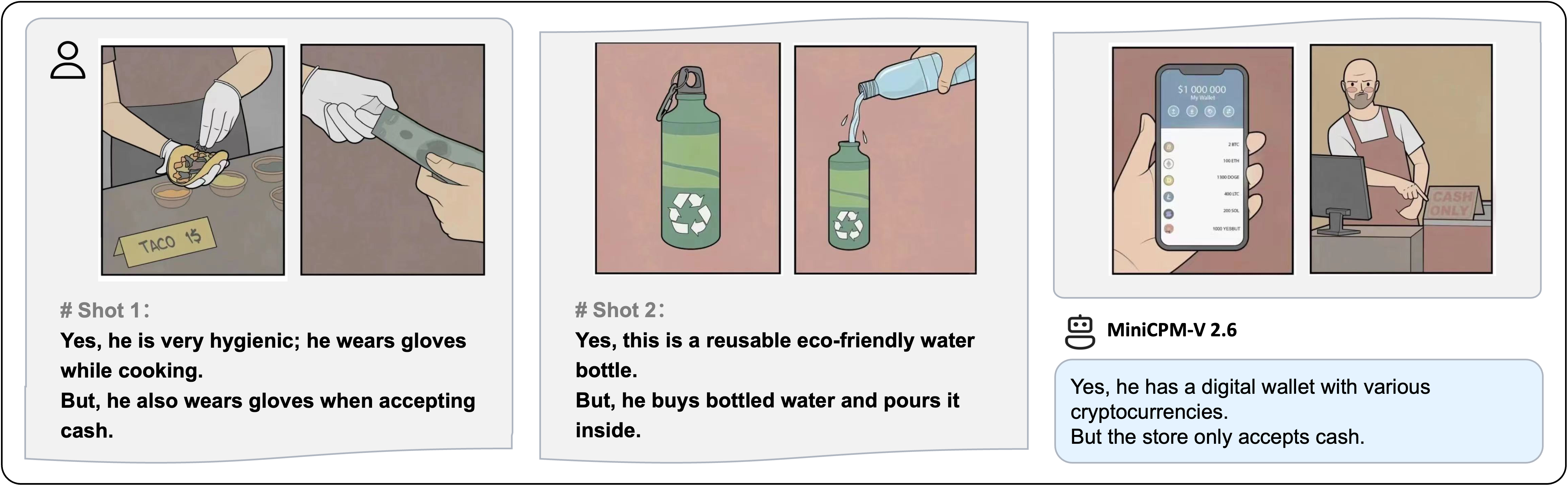
#### In-context Few-shot Learning
Click to view Python code running MiniCPM-V-4 with few-shot input. ```python import torch from PIL import Image from transformers import AutoModel, AutoTokenizer model = AutoModel.from_pretrained('openbmb/MiniCPM-V-4', trust_remote_code=True, # or openbmb/MiniCPM-o-2_6 attn_implementation='sdpa', torch_dtype=torch.bfloat16) # sdpa or flash_attention_2, no eager model = model.eval().cuda() tokenizer = AutoTokenizer.from_pretrained('openbmb/MiniCPM-V-4', trust_remote_code=True) # or openbmb/MiniCPM-o-2_6 question = "production date" image1 = Image.open('example1.jpg').convert('RGB') answer1 = "2023.08.04" image2 = Image.open('example2.jpg').convert('RGB') answer2 = "2007.04.24" image_test = Image.open('test.jpg').convert('RGB') msgs = [ {'role': 'user', 'content': [image1, question]}, {'role': 'assistant', 'content': [answer1]}, {'role': 'user', 'content': [image2, question]}, {'role': 'assistant', 'content': [answer2]}, {'role': 'user', 'content': [image_test, question]} ] answer = model.chat( msgs=msgs, tokenizer=tokenizer ) print(answer) ```
#### Chat with Video
Click to view Python code running MiniCPM-V-4 with video input. ```python import torch from PIL import Image from transformers import AutoModel, AutoTokenizer from decord import VideoReader, cpu # pip install decord model = AutoModel.from_pretrained('openbmb/MiniCPM-V-4', trust_remote_code=True, # or openbmb/MiniCPM-o-2_6 attn_implementation='sdpa', torch_dtype=torch.bfloat16) # sdpa or flash_attention_2, no eager model = model.eval().cuda() tokenizer = AutoTokenizer.from_pretrained('openbmb/MiniCPM-V-4', trust_remote_code=True) # or openbmb/MiniCPM-o-2_6 MAX_NUM_FRAMES=64 # if cuda OOM set a smaller number def encode_video(video_path): def uniform_sample(l, n): gap = len(l) / n idxs = [int(i * gap + gap / 2) for i in range(n)] return [l[i] for i in idxs] vr = VideoReader(video_path, ctx=cpu(0)) sample_fps = round(vr.get_avg_fps() / 1) # FPS frame_idx = [i for i in range(0, len(vr), sample_fps)] if len(frame_idx) > MAX_NUM_FRAMES: frame_idx = uniform_sample(frame_idx, MAX_NUM_FRAMES) frames = vr.get_batch(frame_idx).asnumpy() frames = [Image.fromarray(v.astype('uint8')) for v in frames] print('num frames:', len(frames)) return frames video_path="video_test.mp4" frames = encode_video(video_path) question = "Describe the video" msgs = [ {'role': 'user', 'content': frames + [question]}, ] # Set decode params for video params = {} params["use_image_id"] = False params["max_slice_nums"] = 2 # use 1 if cuda OOM and video resolution > 448*448 answer = model.chat( msgs=msgs, tokenizer=tokenizer, **params ) print(answer) ```
#### Speech and Audio Mode Model initialization ```python import torch import librosa from transformers import AutoModel, AutoTokenizer model = AutoModel.from_pretrained('openbmb/MiniCPM-o-2_6', trust_remote_code=True, attn_implementation='sdpa', torch_dtype=torch.bfloat16) # sdpa or flash_attention_2, no eager model = model.eval().cuda() tokenizer = AutoTokenizer.from_pretrained('openbmb/MiniCPM-o-2_6', trust_remote_code=True) model.init_tts() model.tts.float() ```
##### Mimick `Mimick` task reflects a model's end-to-end speech modeling capability. The model takes audio input, and outputs an ASR transcription and subsequently reconstructs the original audio with high similarity. The higher the similarity between the reconstructed audio and the original audio, the stronger the model's foundational capability in end-to-end speech modeling. ```python mimick_prompt = "Please repeat each user's speech, including voice style and speech content." audio_input, _ = librosa.load('./assets/input_examples/Trump_WEF_2018_10s.mp3', sr=16000, mono=True) # load the audio to be mimicked # `./assets/input_examples/fast-pace.wav`, # `./assets/input_examples/chi-english-1.wav` # `./assets/input_examples/exciting-emotion.wav` # for different aspects of speech-centric features. msgs = [{'role': 'user', 'content': [mimick_prompt, audio_input]}] res = model.chat( msgs=msgs, tokenizer=tokenizer, sampling=True, max_new_tokens=128, use_tts_template=True, temperature=0.3, generate_audio=True, output_audio_path='output_mimick.wav', # save the tts result to output_audio_path ) ```
##### General Speech Conversation with Configurable Voices A general usage scenario of `MiniCPM-o-2.6` is role-playing a specific character based on the audio prompt. It will mimic the voice of the character to some extent and act like the character in text, including language style. In this mode, `MiniCPM-o-2.6` sounds **more natural and human-like**. Self-defined audio prompts can be used to customize the voice of the character in an end-to-end manner. ```python ref_audio, _ = librosa.load('./assets/input_examples/icl_20.wav', sr=16000, mono=True) # load the reference audio sys_prompt = model.get_sys_prompt(ref_audio=ref_audio, mode='audio_roleplay', language='en') # round one user_question = {'role': 'user', 'content': [librosa.load('xxx.wav', sr=16000, mono=True)[0]]} msgs = [sys_prompt, user_question] res = model.chat( msgs=msgs, tokenizer=tokenizer, sampling=True, max_new_tokens=128, use_tts_template=True, generate_audio=True, temperature=0.3, output_audio_path='result_roleplay_round_1.wav', ) # round two history = msgs.append({'role': 'assistant', 'content': res}) user_question = {'role': 'user', 'content': [librosa.load('xxx.wav', sr=16000, mono=True)[0]]} msgs = history.append(user_question) res = model.chat( msgs=msgs, tokenizer=tokenizer, sampling=True, max_new_tokens=128, use_tts_template=True, generate_audio=True, temperature=0.3, output_audio_path='result_roleplay_round_2.wav', ) print(res) ```
##### Speech Conversation as an AI Assistant An enhanced feature of `MiniCPM-o-2.6` is to act as an AI assistant, but only with limited choice of voices. In this mode, `MiniCPM-o-2.6` is **less human-like and more like a voice assistant**. In this mode, the model is more instruction-following. For demo, you are suggested to use `assistant_female_voice`, `assistant_male_voice`, and `assistant_default_female_voice`. Other voices may work but not as stable as the default voices. *Please note that, `assistant_female_voice` and `assistant_male_voice` are more stable but sounds like robots, while `assistant_default_female_voice` is more human-alike but not stable, its voice often changes in multiple turns. We suggest you to try stable voices `assistant_female_voice` and `assistant_male_voice`.* ```python ref_audio, _ = librosa.load('./assets/input_examples/assistant_female_voice.wav', sr=16000, mono=True) # or use `./assets/input_examples/assistant_male_voice.wav` sys_prompt = model.get_sys_prompt(ref_audio=ref_audio, mode='audio_assistant', language='en') user_question = {'role': 'user', 'content': [librosa.load('xxx.wav', sr=16000, mono=True)[0]]} # load the user's audio question # round one msgs = [sys_prompt, user_question] res = model.chat( msgs=msgs, tokenizer=tokenizer, sampling=True, max_new_tokens=128, use_tts_template=True, generate_audio=True, temperature=0.3, output_audio_path='result_assistant_round_1.wav', ) # round two history = msgs.append({'role': 'assistant', 'content': res}) user_question = {'role': 'user', 'content': [librosa.load('xxx.wav', sr=16000, mono=True)[0]]} msgs = history.append(user_question) res = model.chat( msgs=msgs, tokenizer=tokenizer, sampling=True, max_new_tokens=128, use_tts_template=True, generate_audio=True, temperature=0.3, output_audio_path='result_assistant_round_2.wav', ) print(res) ```
##### Instruction-to-Speech `MiniCPM-o-2.6` can also do Instruction-to-Speech, aka **Voice Creation**. You can describe a voice in detail, and the model will generate a voice that matches the description. For more Instruction-to-Speech sample instructions, you can refer to https://voxinstruct.github.io/VoxInstruct/. ```python instruction = 'Speak like a male charming superstar, radiating confidence and style in every word.' msgs = [{'role': 'user', 'content': [instruction]}] res = model.chat( msgs=msgs, tokenizer=tokenizer, sampling=True, max_new_tokens=128, use_tts_template=True, generate_audio=True, temperature=0.3, output_audio_path='result_voice_creation.wav', ) ```
##### Voice Cloning `MiniCPM-o-2.6` can also do zero-shot text-to-speech, aka **Voice Cloning**. With this mode, model will act like a TTS model. ```python ref_audio, _ = librosa.load('./assets/input_examples/icl_20.wav', sr=16000, mono=True) # load the reference audio sys_prompt = model.get_sys_prompt(ref_audio=ref_audio, mode='voice_cloning', language='en') text_prompt = f"Please read the text below." user_question = {'role': 'user', 'content': [text_prompt, "content that you want to read"]} msgs = [sys_prompt, user_question] res = model.chat( msgs=msgs, tokenizer=tokenizer, sampling=True, max_new_tokens=128, use_tts_template=True, generate_audio=True, temperature=0.3, output_audio_path='result_voice_cloning.wav', ) ```
##### Addressing Various Audio Understanding Tasks `MiniCPM-o-2.6` can also be used to address various audio understanding tasks, such as ASR, speaker analysis, general audio captioning, and sound scene tagging. For audio-to-text tasks, you can use the following prompts: - ASR with ZH(same as AST en2zh): `请仔细听这段音频片段,并将其内容逐字记录。` - ASR with EN(same as AST zh2en): `Please listen to the audio snippet carefully and transcribe the content.` - Speaker Analysis: `Based on the speaker's content, speculate on their gender, condition, age range, and health status.` - General Audio Caption: `Summarize the main content of the audio.` - General Sound Scene Tagging: `Utilize one keyword to convey the audio's content or the associated scene.` ```python task_prompt = "Please listen to the audio snippet carefully and transcribe the content." + "\n" # can change to other prompts. audio_input, _ = librosa.load('./assets/input_examples/audio_understanding.mp3', sr=16000, mono=True) # load the audio to be captioned msgs = [{'role': 'user', 'content': [task_prompt, audio_input]}] res = model.chat( msgs=msgs, tokenizer=tokenizer, sampling=True, max_new_tokens=128, use_tts_template=True, generate_audio=True, temperature=0.3, output_audio_path='result_audio_understanding.wav', ) print(res) ``` #### Multimodal Live Streaming
Click to view Python code running MiniCPM-o 2.6 with chat inference. ```python import math import numpy as np from PIL import Image from moviepy.editor import VideoFileClip import tempfile import librosa import soundfile as sf import torch from transformers import AutoModel, AutoTokenizer def get_video_chunk_content(video_path, flatten=True): video = VideoFileClip(video_path) print('video_duration:', video.duration) with tempfile.NamedTemporaryFile(suffix=".wav", delete=True) as temp_audio_file: temp_audio_file_path = temp_audio_file.name video.audio.write_audiofile(temp_audio_file_path, codec="pcm_s16le", fps=16000) audio_np, sr = librosa.load(temp_audio_file_path, sr=16000, mono=True) num_units = math.ceil(video.duration) # 1 frame + 1s audio chunk contents= [] for i in range(num_units): frame = video.get_frame(i+1) image = Image.fromarray((frame).astype(np.uint8)) audio = audio_np[sr*i:sr*(i+1)] if flatten: contents.extend(["", image, audio]) else: contents.append(["", image, audio]) return contents model = AutoModel.from_pretrained('openbmb/MiniCPM-o-2_6', trust_remote_code=True, attn_implementation='sdpa', torch_dtype=torch.bfloat16) model = model.eval().cuda() tokenizer = AutoTokenizer.from_pretrained('openbmb/MiniCPM-o-2_6', trust_remote_code=True) model.init_tts() # If you are using an older version of PyTorch, you might encounter this issue "weight_norm_fwd_first_dim_kernel" not implemented for 'BFloat16', Please convert the TTS to float32 type. # model.tts.float() # https://huggingface.co/openbmb/MiniCPM-o-2_6/blob/main/assets/Skiing.mp4 video_path="assets/Skiing.mp4" sys_msg = model.get_sys_prompt(mode='omni', language='en') # if use voice clone prompt, please set ref_audio # ref_audio_path = '/path/to/ref_audio' # ref_audio, _ = librosa.load(ref_audio_path, sr=16000, mono=True) # sys_msg = model.get_sys_prompt(ref_audio=ref_audio, mode='omni', language='en') contents = get_video_chunk_content(video_path) msg = {"role":"user", "content": contents} msgs = [sys_msg, msg] # please set generate_audio=True and output_audio_path to save the tts result generate_audio = True output_audio_path = 'output.wav' res = model.chat( msgs=msgs, tokenizer=tokenizer, sampling=True, temperature=0.5, max_new_tokens=4096, omni_input=True, # please set omni_input=True when omni inference use_tts_template=True, generate_audio=generate_audio, output_audio_path=output_audio_path, max_slice_nums=1, use_image_id=False, return_dict=True ) print(res) ```
Click to view Python code running MiniCPM-o 2.6 with streaming inference. Note: The streaming inference has a slight performance degradation because the audio encoding is not global. ```python # a new conversation need reset session first, it will reset the kv-cache model.reset_session() contents = get_video_chunk_content(video_path, flatten=False) session_id = '123' generate_audio = True # 1. prefill system prompt res = model.streaming_prefill( session_id=session_id, msgs=[sys_msg], tokenizer=tokenizer ) # 2. prefill video/audio chunks for content in contents: msgs = [{"role":"user", "content": content}] res = model.streaming_prefill( session_id=session_id, msgs=msgs, tokenizer=tokenizer ) # 3. generate res = model.streaming_generate( session_id=session_id, tokenizer=tokenizer, temperature=0.5, generate_audio=generate_audio ) audios = [] text = "" if generate_audio: for r in res: audio_wav = r.audio_wav sampling_rate = r.sampling_rate txt = r.text audios.append(audio_wav) text += txt res = np.concatenate(audios) sf.write("output.wav", res, samplerate=sampling_rate) print("text:", text) print("audio saved to output.wav") else: for r in res: text += r['text'] print("text:", text) ```
### Inference on Multiple GPUs You can run MiniCPM-Llama3-V 2.5 on multiple low VRAM GPUs (12 GB or 16 GB) by distributing the model's layers across multiple GPUs. Please refer to this [tutorial](https://github.com/OpenBMB/MiniCPM-V/blob/main/docs/inference_on_multiple_gpus.md) for detailed instructions on how to load the model and inference using multiple low VRAM GPUs. ### Inference on Mac
Click to view an example, to run MiniCPM-Llama3-V 2.5 on 💻 Mac with MPS (Apple silicon or AMD GPUs). ```python # test.py Need more than 16GB memory. import torch from PIL import Image from transformers import AutoModel, AutoTokenizer model = AutoModel.from_pretrained('openbmb/MiniCPM-Llama3-V-2_5', trust_remote_code=True, low_cpu_mem_usage=True) model = model.to(device='mps') tokenizer = AutoTokenizer.from_pretrained('openbmb/MiniCPM-Llama3-V-2_5', trust_remote_code=True) model.eval() image = Image.open('./assets/hk_OCR.jpg').convert('RGB') question = 'Where is this photo taken?' msgs = [{'role': 'user', 'content': question}] answer, context, _ = model.chat( image=image, msgs=msgs, context=None, tokenizer=tokenizer, sampling=True ) print(answer) ``` Run with command: ```shell PYTORCH_ENABLE_MPS_FALLBACK=1 python test.py ```
### Efficient Inference with llama.cpp, Ollama, vLLM See [our fork of llama.cpp](https://github.com/OpenBMB/llama.cpp/tree/minicpmv-main/examples/llava/README-minicpmv2.6.md) for more detail. This implementation supports smooth inference of 16~18 token/s on iPad (test environment:iPad Pro + M4). See [our fork of Ollama](https://github.com/OpenBMB/ollama/blob/minicpm-v2.6/examples/minicpm-v2.6/README.md) for more detail. This implementation supports smooth inference of 16~18 token/s on iPad (test environment:iPad Pro + M4).
vLLM now officially supports MiniCPM-V 2.6, MiniCPM-Llama3-V 2.5 and MiniCPM-V 2.0. And you can use our fork to run MiniCPM-o 2.6 for now. Click to see. 1. Install vLLM(>=0.7.1): ```shell pip install vllm ``` 2. Run Example: * [Vision Language](https://docs.vllm.ai/en/latest/getting_started/examples/vision_language.html) * [Audio Language](https://docs.vllm.ai/en/latest/getting_started/examples/audio_language.html)
## Fine-tuning ### Simple Fine-tuning We support simple fine-tuning with Hugging Face for MiniCPM-o 2.6, MiniCPM-V 2.6, MiniCPM-Llama3-V 2.5 and MiniCPM-V 2.0. [Reference Document](./finetune/readme.md) ### With Align-Anything We support fine-tuning MiniCPM-o 2.6 by PKU-Alignment Team (both vision and audio, SFT and DPO) with the [Align-Anything framework](https://github.com/PKU-Alignment/align-anything). Align-Anything is a scalable framework that aims to align any-modality large models with human intentions, open-sourcing the [datasets, models and benchmarks](https://huggingface.co/datasets/PKU-Alignment/align-anything). Benefiting from its concise and modular design, it supports 30+ open-source benchmarks, 40+ models and algorithms including SFT, SimPO, RLHF, *etc*. It also provides 30+ directly runnable scripts, making it suitable for beginners to quickly get started. Best Practices: [MiniCPM-o 2.6](https://github.com/PKU-Alignment/align-anything/tree/main/scripts). ### With LLaMA-Factory We support fine-tuning MiniCPM-o 2.6 and MiniCPM-V 2.6 with the LLaMA-Factory framework. LLaMA-Factory provides a solution for flexibly customizing the fine-tuning (Lora/Full/Qlora) of 200+ LLMs without the need for coding through the built-in web UI LLaMABoard. It supports various training methods like sft/ppo/dpo/kto and advanced algorithms like Galore/BAdam/LLaMA-Pro/Pissa/LongLoRA. Best Practices: [MiniCPM-o 2.6 | MiniCPM-V 2.6](./docs/llamafactory_train_and_infer.md). ### With the SWIFT Framework We now support MiniCPM-V series fine-tuning with the SWIFT framework. SWIFT supports training, inference, evaluation and deployment of nearly 200 LLMs and MLLMs . It supports the lightweight training solutions provided by PEFT and a complete Adapters Library including techniques such as NEFTune, LoRA+ and LLaMA-PRO. Best Practices:[MiniCPM-V 1.0](https://github.com/modelscope/swift/blob/main/docs/source/Multi-Modal/minicpm-v最佳实践.md), [MiniCPM-V 2.0](https://github.com/modelscope/swift/blob/main/docs/source/Multi-Modal/minicpm-v-2最佳实践.md), [MiniCPM-V 2.6](https://github.com/modelscope/ms-swift/issues/1613). ## Awesome work using MiniCPM-V & MiniCPM-o - [text-extract-api](https://github.com/CatchTheTornado/text-extract-api): Document extraction API using OCRs and Ollama supported models ![GitHub Repo stars](https://img.shields.io/github/stars/CatchTheTornado/text-extract-api) - [comfyui_LLM_party](https://github.com/heshengtao/comfyui_LLM_party): Build LLM workflows and integrate into existing image workflows ![GitHub Repo stars](https://img.shields.io/github/stars/heshengtao/comfyui_LLM_party) - [Ollama-OCR](https://github.com/imanoop7/Ollama-OCR): OCR package uses vlms through Ollama to extract text from images and PDF ![GitHub Repo stars](https://img.shields.io/github/stars/imanoop7/Ollama-OCR) - [comfyui-mixlab-nodes](https://github.com/MixLabPro/comfyui-mixlab-nodes): ComfyUI node suite supports Workflow-to-APP、GPT&3D and more ![GitHub Repo stars](https://img.shields.io/github/stars/MixLabPro/comfyui-mixlab-nodes) - [OpenAvatarChat](https://github.com/HumanAIGC-Engineering/OpenAvatarChat): Interactive digital human conversation implementation on single PC ![GitHub Repo stars](https://img.shields.io/github/stars/HumanAIGC-Engineering/OpenAvatarChat) - [pensieve](https://github.com/arkohut/pensieve): A privacy-focused passive recording project by recording screen content ![GitHub Repo stars](https://img.shields.io/github/stars/arkohut/pensieve) - [paperless-gpt](https://github.com/icereed/paperless-gpt): Use LLMs to handle paperless-ngx, AI-powered titles, tags and OCR ![GitHub Repo stars](https://img.shields.io/github/stars/icereed/paperless-gpt) - [Neuro](https://github.com/kimjammer/Neuro): A recreation of Neuro-Sama, but running on local models on consumer hardware ![GitHub Repo stars](https://img.shields.io/github/stars/kimjammer/Neuro) ## FAQs Click here to view the [FAQs](./docs/faqs.md) ## Limitations As an experimental trial, we find MiniCPM-o 2.6 has notable limitations worth further investigation and improvement. - **Unstable speech output.** The speech generation can be flawed with noisy backgrounds and unmeaningful sounds. - **Repeated response.** The model tends to repeat its response when encountering similar consecutive user queries. - **High-latency on Web Demo.** Users may experience unusual high-latency when using web demo hosted on overseas servers. We recommend deploying the demo locally or with good network connections. ## Model License * This repository is released under the [Apache-2.0](https://github.com/OpenBMB/MiniCPM/blob/main/LICENSE) License. * The usage of MiniCPM-o/V model weights must strictly follow [MiniCPM Model License.md](https://github.com/OpenBMB/MiniCPM/blob/main/MiniCPM%20Model%20License.md). * The models and weights of MiniCPM are completely free for academic research. after filling out a ["questionnaire"](https://modelbest.feishu.cn/share/base/form/shrcnpV5ZT9EJ6xYjh3Kx0J6v8g) for registration, are also available for free commercial use. ## Statement As MLLMs, MiniCPM-o/V models generate content by learning a large number of multimodal corpora, but they cannot comprehend, express personal opinions, or make value judgements. Anything generated by MiniCPM-o/V models does not represent the views and positions of the model developers We will not be liable for any problems arising from the use of MiniCPM-o/V models, including but not limited to data security issues, risk of public opinion, or any risks and problems arising from the misdirection, misuse, dissemination, or misuse of the model. ## Institutions This project is developed by the following institutions: - [THUNLP](https://nlp.csai.tsinghua.edu.cn/) - [ModelBest](https://modelbest.cn/) ## 🌟 Star History Star History Chart ## Key Techniques and Other Multimodal Projects 👏 Welcome to explore key techniques of MiniCPM-o/V and other multimodal projects of our team: [VisCPM](https://github.com/OpenBMB/VisCPM/tree/main) | [RLHF-V](https://github.com/RLHF-V/RLHF-V) | [LLaVA-UHD](https://github.com/thunlp/LLaVA-UHD) | [RLAIF-V](https://github.com/RLHF-V/RLAIF-V) ## Citation If you find our model/code/paper helpful, please consider citing our papers 📝 and staring us ⭐️! ```bib @article{yao2024minicpm, title={MiniCPM-V: A GPT-4V Level MLLM on Your Phone}, author={Yao, Yuan and Yu, Tianyu and Zhang, Ao and Wang, Chongyi and Cui, Junbo and Zhu, Hongji and Cai, Tianchi and Li, Haoyu and Zhao, Weilin and He, Zhihui and others}, journal={arXiv preprint arXiv:2408.01800}, year={2024} } ```