
**A GPT-4V Level Multimodal LLM on Your Phone**
[中文](./README_zh.md) |
English
MiniCPM-Llama3-V 2.5 🤗 🤖 |
MiniCPM-V 2.0 🤗 🤖 |
Technical Blog
**MiniCPM-V** is a series of end-side multimodal LLMs (MLLMs) designed for vision-language understanding. Models take image and text as inputs and provide high-quality text outputs. Since February 2024, we have released 4 versions of the model, aiming to achieve **strong performance and efficient deployment**! The most noteworthy models in this series currently include:
- **MiniCPM-Llama3-V 2.5**: 🔥🔥🔥 The latest and most capable model in the MiniCPM-V series. With a total of 8B parameters, the model surpasses proprietary models such as GPT-4V-1106, Gemini Pro, Qwen-VL-Max and Claude 3 in overall performance. Equipped with the enhanced OCR and instruction-following capability, the model can also support multimodal conversation for over 30 languages including English, Chinese, French, Spanish, German etc. With help of quantization, compilation optimizations, and several efficient inference technologies on CPUs and NPUs, MiniCPM-Llama3-V 2.5 can be efficiently deployed on end-side devices.
- **MiniCPM-V 2.0**: The lightest model in the MiniCPM-V series. With 2B parameters, it surpasses larger models such as Yi-VL 34B, CogVLM-Chat 17B, and Qwen-VL-Chat 10B in overall performance. It can accept image inputs of any aspect ratio and up to 1.8 million pixels (e.g., 1344x1344), achieving comparable performance with Gemini Pro in understanding scene-text and matches GPT-4V in low hallucination rates.
## News
* [2024.05.23] We've released a comprehensive comparison between Phi-3-vision-128k-instruct and MiniCPM-Llama3-V 2.5, including benchmarks evaluations, and multilingual capabilities 🌟📊🌍. Click [here](./docs/compare_with_phi-3_vision.md) to view more details.
* [2024.05.20] We open-soure MiniCPM-Llama3-V 2.5, it has improved OCR capability and supports 30+ languages, representing the first edge-side MLLM achieving GPT-4V level performance! We provide [efficient inference](#deployment-on-mobile-phone) and [simple fine-tuning](./finetune/readme.md). Try it now!
* [2024.04.23] MiniCPM-V-2.0 supports vLLM now! Click [here](#vllm) to view more details.
* [2024.04.18] We create a HuggingFace Space to host the demo of MiniCPM-V 2.0 at [here](https://huggingface.co/spaces/openbmb/MiniCPM-V-2)!
* [2024.04.17] MiniCPM-V-2.0 supports deploying [WebUI Demo](#webui-demo) now!
* [2024.04.15] MiniCPM-V-2.0 now also supports [fine-tuning](https://github.com/modelscope/swift/blob/main/docs/source/Multi-Modal/minicpm-v-2最佳实践.md) with the SWIFT framework!
* [2024.04.12] We open-source MiniCPM-V 2.0, which achieves comparable performance with Gemini Pro in understanding scene text and outperforms strong Qwen-VL-Chat 9.6B and Yi-VL 34B on OpenCompass, a comprehensive evaluation over 11 popular benchmarks. Click here to view the MiniCPM-V 2.0 technical blog.
* [2024.03.14] MiniCPM-V now supports [fine-tuning](https://github.com/modelscope/swift/blob/main/docs/source/Multi-Modal/minicpm-v最佳实践.md) with the SWIFT framework. Thanks to [Jintao](https://github.com/Jintao-Huang) for the contribution!
* [2024.03.01] MiniCPM-V now can be deployed on Mac!
* [2024.02.01] We open-source MiniCPM-V and OmniLMM-12B, which support efficient end-side deployment and powerful multimodal capabilities correspondingly.
## Contents
- [MiniCPM-Llama3-V 2.5](#minicpm-llama3-v-25)
- [Evaluation](#evaluation)
- [MiniCPM-V 2.0](#minicpm-v-20)
- [Online Demo](#online-demo)
- [Install](#install)
- [Inference](#inference)
- [Hardware Requirements](#hardware-requirements)
- [Model Zoo](#model-zoo)
- [Multi-turn Conversation](#multi-turn-conversation)
- [Inference on Mac](#inference-on-mac)
- [Deployment on Mobile Phone](#deployment-on-mobile-phone)
- [WebUI Demo](#webui-demo)
- [Inference with vLLM](#inference-with-vllm)
- [Fine-tuning](#fine-tuning)
- [TODO](#todo)
- [Citation](#citation)
## MiniCPM-Llama3-V 2.5
**MiniCPM-Llama3-V 2.5** is the latest model in the MiniCPM-V series. The model is built on SigLip-400M and Llama3-8B-Instruct with a total of 8B parameters. It exhibits a significant performance improvement over MiniCPM-V 2.0. Notable features of MiniCPM-Llama3-V 2.5 include:
- 🔥 **Leading Performance.**
MiniCPM-Llama3-V 2.5 has achieved an average score of 65.1 on OpenCompass, a comprehensive evaluation over 11 popular benchmarks. **With only 8B parameters, it surpasses widely used proprietary models like GPT-4V-1106, Gemini Pro, Claude 3 and Qwen-VL-Max** and greatly outperforms other Llama 3-based MLLMs.
- 💪 **Strong OCR Capabilities.**
MiniCPM-Llama3-V 2.5 can process images with any aspect ratio and up to 1.8 million pixels (e.g., 1344x1344), achieving an **700+ score on OCRBench, surpassing proprietary models such as GPT-4o, GPT-4V-0409, Qwen-VL-Max and Gemini Pro**. Based on recent user feedback, MiniCPM-Llama3-V 2.5 has now enhanced full-text OCR extraction, table-to-markdown conversion, and other high-utility capabilities, and has further strengthened its instruction-following and complex reasoning abilities, enhancing multimodal interaction experiences.
- 🏆 **Trustworthy Behavior.**
Leveraging the latest [RLAIF-V](https://github.com/RLHF-V/RLAIF-V/) method (the newest technology in the [RLHF-V](https://github.com/RLHF-V) [CVPR'24] series), MiniCPM-Llama3-V 2.5 exhibits more trustworthy behavior. It achieves **10.3%** hallucination rate on Object HalBench, lower than GPT-4V-1106 (13.6%), achieving the best-level performance within the open-source community.
- 🌏 **Multilingual Support.**
Thanks to the strong multilingual capabilities of Llama 3 and the cross-lingual generalization technique from [VisCPM](https://github.com/OpenBMB/VisCPM), MiniCPM-Llama3-V 2.5 extends its bilingual (Chinese-English) multimodal capabilities to **over 30 languages including German, French, Spanish, Italian, Russian etc.** [All Supported Languages](./assets/minicpm-llama-v-2-5_languages.md).
- 🚀 **Efficient Deployment.**
MiniCPM-Llama3-V 2.5 systematically employs **model quantization, CPU optimizations, NPU optimizations and compilation optimizations**, achieving high-efficiency deployment on edge devices. For mobile phones with Qualcomm chips, we have integrated the NPU acceleration framework QNN into llama.cpp for the first time. After systematic optimization, MiniCPM-Llama3-V 2.5 has realized a **150-fold acceleration in multimodal large model edge-side image encoding** and a **3-fold increase in language decoding speed**.
### Evaluation
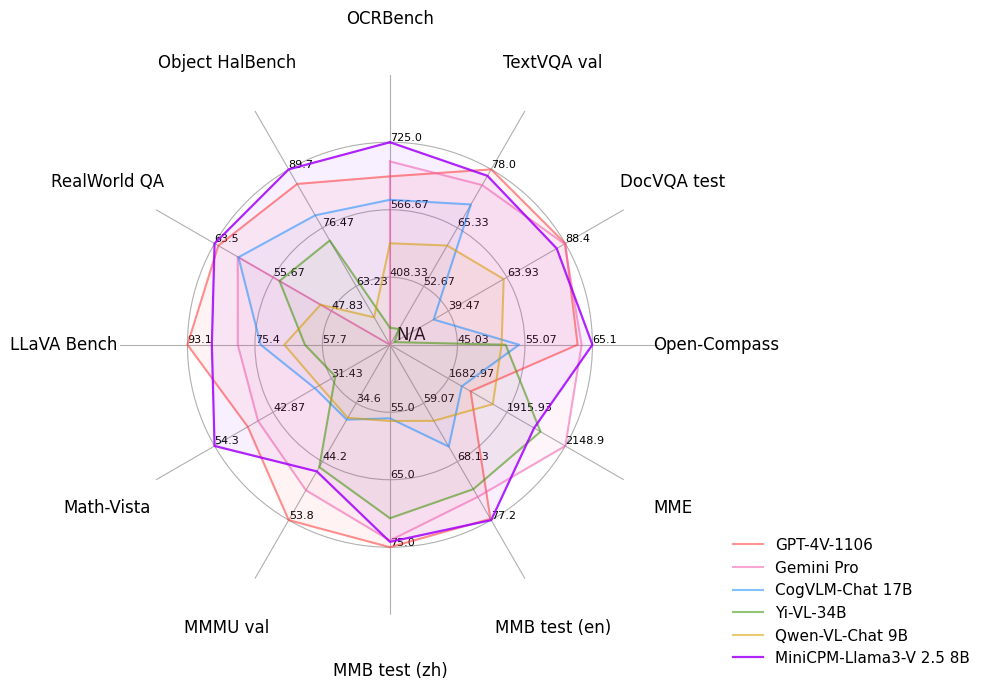
Click to view results on TextVQA, DocVQA, OCRBench, OpenCompass, MME, MMBench, MMMU, MathVista, LLaVA Bench, RealWorld QA, Object HalBench.
| Model |
Size |
OCRBench |
TextVQA val |
DocVQA test |
Open-Compass |
MME |
MMB test (en) |
MMB test (cn) |
MMMU val |
Math-Vista |
LLaVA Bench |
RealWorld QA |
Object HalBench |
| Proprietary |
| Gemini Pro |
- |
680 |
74.6 |
88.1 |
62.9 |
2148.9 |
73.6 |
74.3 |
48.9 |
45.8 |
79.9 |
60.4 |
- |
| GPT-4V (2023.11.06) |
- |
645 |
78.0 |
88.4 |
63.5 |
1771.5 |
77.0 |
74.4 |
53.8 |
47.8 |
93.1 |
63.0 |
86.4 |
| Open-source |
| Mini-Gemini |
2.2B |
- |
56.2 |
34.2* |
- |
1653.0 |
- |
- |
31.7 |
- |
- |
- |
- |
| Qwen-VL-Chat |
9.6B |
488 |
61.5 |
62.6 |
51.6 |
1860.0 |
61.8 |
56.3 |
37.0 |
33.8 |
67.7 |
49.3 |
56.2 |
| DeepSeek-VL-7B |
7.3B |
435 |
64.7* |
47.0* |
54.6 |
1765.4 |
73.8 |
71.4 |
38.3 |
36.8 |
77.8 |
54.2 |
- |
| Yi-VL-34B |
34B |
290 |
43.4* |
16.9* |
52.2 |
2050.2 |
72.4 |
70.7 |
45.1 |
30.7 |
62.3 |
54.8 |
79.3 |
| CogVLM-Chat |
17.4B |
590 |
70.4 |
33.3* |
54.2 |
1736.6 |
65.8 |
55.9 |
37.3 |
34.7 |
73.9 |
60.3 |
73.6 |
| TextMonkey |
9.7B |
558 |
64.3 |
66.7 |
- |
- |
- |
- |
- |
- |
- |
- |
- |
| Idefics2 |
8.0B |
- |
73.0 |
74.0 |
57.2 |
1847.6 |
75.7 |
68.6 |
45.2 |
52.2 |
49.1 |
60.7 |
- |
| Bunny-LLama-3-8B |
8.4B |
- |
- |
- |
54.3 |
1920.3 |
77.0 |
73.9 |
41.3 |
31.5 |
61.2 |
58.8 |
- |
| LLaVA-NeXT Llama-3-8B |
8.4B |
- |
- |
78.2 |
- |
1971.5 |
- |
- |
41.7 |
37.5 |
80.1 |
60.0 |
- |
| Phi-3-vision-128k-instruct |
4.2B |
639* |
70.9 |
- |
- |
1537.5* |
- |
- |
40.4 |
44.5 |
64.2* |
58.8* |
- |
| MiniCPM-V 1.0 |
2.8B |
366 |
60.6 |
38.2 |
47.5 |
1650.2 |
64.1 |
62.6 |
38.3 |
28.9 |
51.3 |
51.2 |
78.4 |
| MiniCPM-V 2.0 |
2.8B |
605 |
74.1 |
71.9 |
54.5 |
1808.6 |
69.1 |
66.5 |
38.2 |
38.7 |
69.2 |
55.8 |
85.5 |
| MiniCPM-Llama3-V 2.5 |
8.5B |
725 |
76.6 |
84.8 |
65.1 |
2024.6 |
77.2 |
74.2 |
45.8 |
54.3 |
86.7 |
63.5 |
89.7 |
* We evaluate the officially released checkpoint by ourselves.
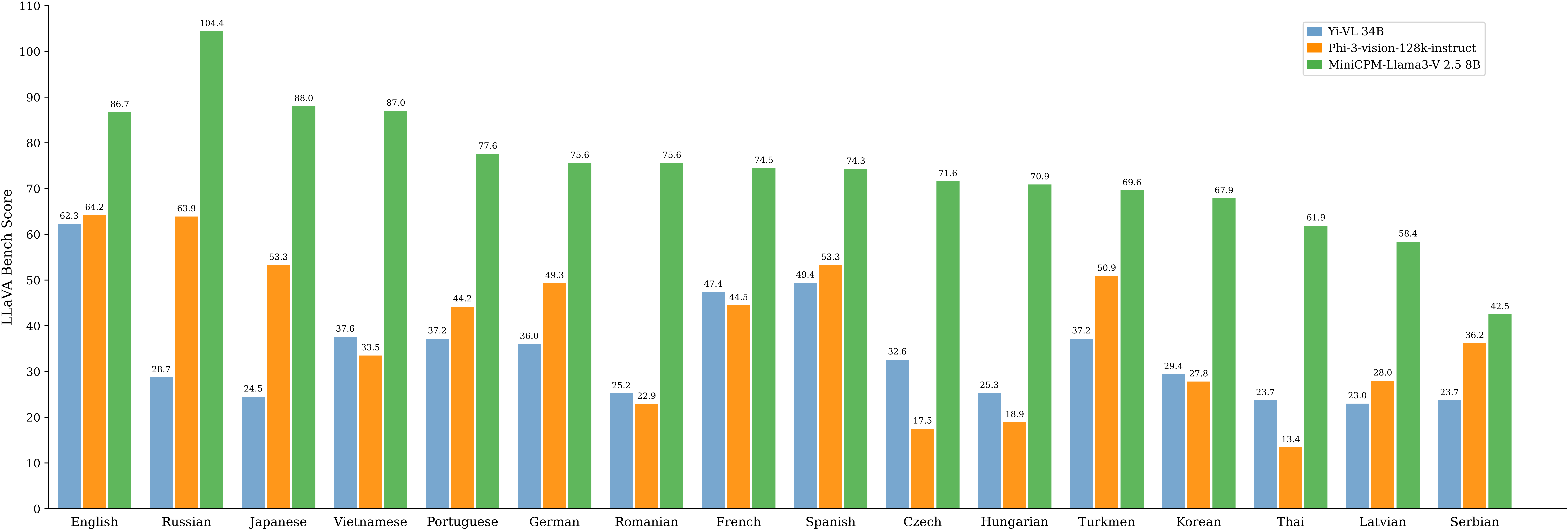
Evaluation results of LLaVABench in multiple languages
### Examples

We deploy MiniCPM-Llama3-V 2.5 on end devices. The demo video is the raw screen recording on a Xiaomi 14 Pro without edition.


## MiniCPM-V 2.0
Click to view more details of MiniCPM-V 2.0
**MiniCPM-V 2.0** is an efficient version with promising performance for deployment. The model is built based on SigLip-400M and [MiniCPM-2.4B](https://github.com/OpenBMB/MiniCPM/), connected by a perceiver resampler. Our latest version, MiniCPM-V 2.0 has several notable features.
- 🔥 **State-of-the-art Performance.**
MiniCPM-V 2.0 achieves **state-of-the-art performance** on multiple benchmarks (including OCRBench, TextVQA, MME, MMB, MathVista, etc) among models under 7B parameters. It even **outperforms strong Qwen-VL-Chat 9.6B, CogVLM-Chat 17.4B, and Yi-VL 34B on OpenCompass, a comprehensive evaluation over 11 popular benchmarks**. Notably, MiniCPM-V 2.0 shows **strong OCR capability**, achieving **comparable performance to Gemini Pro in scene-text understanding**, and **state-of-the-art performance on OCRBench** among open-source models.
- 🏆 **Trustworthy Behavior.**
LMMs are known for suffering from hallucination, often generating text not factually grounded in images. MiniCPM-V 2.0 is **the first end-side LMM aligned via multimodal RLHF for trustworthy behavior** (using the recent [RLHF-V](https://rlhf-v.github.io/) [CVPR'24] series technique). This allows the model to **match GPT-4V in preventing hallucinations** on Object HalBench.
- 🌟 **High-Resolution Images at Any Aspect Raito.**
MiniCPM-V 2.0 can accept **1.8 million pixels (e.g., 1344x1344) images at any aspect ratio**. This enables better perception of fine-grained visual information such as small objects and optical characters, which is achieved via a recent technique from [LLaVA-UHD](https://arxiv.org/pdf/2403.11703.pdf).
- ⚡️ **High Efficiency.**
MiniCPM-V 2.0 can be **efficiently deployed on most GPU cards and personal computers**, and **even on end devices such as mobile phones**. For visual encoding, we compress the image representations into much fewer tokens via a perceiver resampler. This allows MiniCPM-V 2.0 to operate with **favorable memory cost and speed during inference even when dealing with high-resolution images**.
- 🙌 **Bilingual Support.**
MiniCPM-V 2.0 **supports strong bilingual multimodal capabilities in both English and Chinese**. This is enabled by generalizing multimodal capabilities across languages, a technique from [VisCPM](https://arxiv.org/abs/2308.12038) [ICLR'24].
### Examples
We deploy MiniCPM-V 2.0 on end devices. The demo video is the raw screen recording on a Xiaomi 14 Pro without edition.
## Legacy Models
| Model | Introduction and Guidance |
|:----------------------|:-------------------:|
| MiniCPM-V 1.0 | [Document](./minicpm_v1.md) |
| OmniLMM-12B | [Document](./omnilmm_en.md) |
## Online Demo
Click here to try out the Demo of [MiniCPM-Llama3-V 2.5](https://huggingface.co/spaces/openbmb/MiniCPM-Llama3-V-2_5) | [MiniCPM-V 2.0](https://huggingface.co/spaces/openbmb/MiniCPM-V-2).
## Install
1. Clone this repository and navigate to the source folder
```bash
git clone https://github.com/OpenBMB/MiniCPM-V.git
cd MiniCPM-V
```
2. Create conda environment
```Shell
conda create -n MiniCPM-V python=3.10 -y
conda activate MiniCPM-V
```
3. Install dependencies
```shell
pip install -r requirements.txt
```
## Inference
### Hardware Requirements
| Model | GPU Memory |
|:----------------------|:-------------------:|
| MiniCPM-Llama3-V 2.5 | 19 GB |
| MiniCPM-Llama3-V 2.5 (int4) | 8 GB |
| MiniCPM-Llama3-V 2.0 | 8 GB |
### Model Zoo
| Model | Description | Download Link |
|:----------------------|:-------------------|:---------------:|
| MiniCPM-Llama3-V 2.5 | The lastest version, achieving state-of-the edge-side multimodal performance. | [🤗](https://huggingface.co/openbmb/MiniCPM-Llama3-V-2_5/) [ ](https://modelscope.cn/models/OpenBMB/MiniCPM-Llama3-V-2_5) |
| MiniCPM-Llama3-V 2.5 int4 | int4 quantized version,lower GPU memory usage. | [🤗](https://huggingface.co/openbmb/MiniCPM-Llama3-V-2_5-int4/) [](https://modelscope.cn/models/OpenBMB/MiniCPM-Llama3-V-2_5-int4) |
| MiniCPM-V 2.0 | Light version, balance the performance the computation cost. | [🤗](https://huggingface.co/openbmb/MiniCPM-V-2) [](https://modelscope.cn/models/OpenBMB/MiniCPM-V-2) |
| MiniCPM-V 1.0 | Lightest version, achieving the fastest inference. | [🤗](https://huggingface.co/openbmb/MiniCPM-V) [](https://modelscope.cn/models/OpenBMB/MiniCPM-V) |
### Multi-turn Conversation
Please refer to the following codes to run `MiniCPM-V` and `OmniLMM`.
](https://modelscope.cn/models/OpenBMB/MiniCPM-Llama3-V-2_5) |
| MiniCPM-Llama3-V 2.5 int4 | int4 quantized version,lower GPU memory usage. | [🤗](https://huggingface.co/openbmb/MiniCPM-Llama3-V-2_5-int4/) [](https://modelscope.cn/models/OpenBMB/MiniCPM-Llama3-V-2_5-int4) |
| MiniCPM-V 2.0 | Light version, balance the performance the computation cost. | [🤗](https://huggingface.co/openbmb/MiniCPM-V-2) [](https://modelscope.cn/models/OpenBMB/MiniCPM-V-2) |
| MiniCPM-V 1.0 | Lightest version, achieving the fastest inference. | [🤗](https://huggingface.co/openbmb/MiniCPM-V) [](https://modelscope.cn/models/OpenBMB/MiniCPM-V) |
### Multi-turn Conversation
Please refer to the following codes to run `MiniCPM-V` and `OmniLMM`.
```python
from chat import OmniLMMChat, img2base64
import torch
import json
torch.manual_seed(0)
chat_model = OmniLMMChat('openbmb/MiniCPM-Llama3-V-2_5')
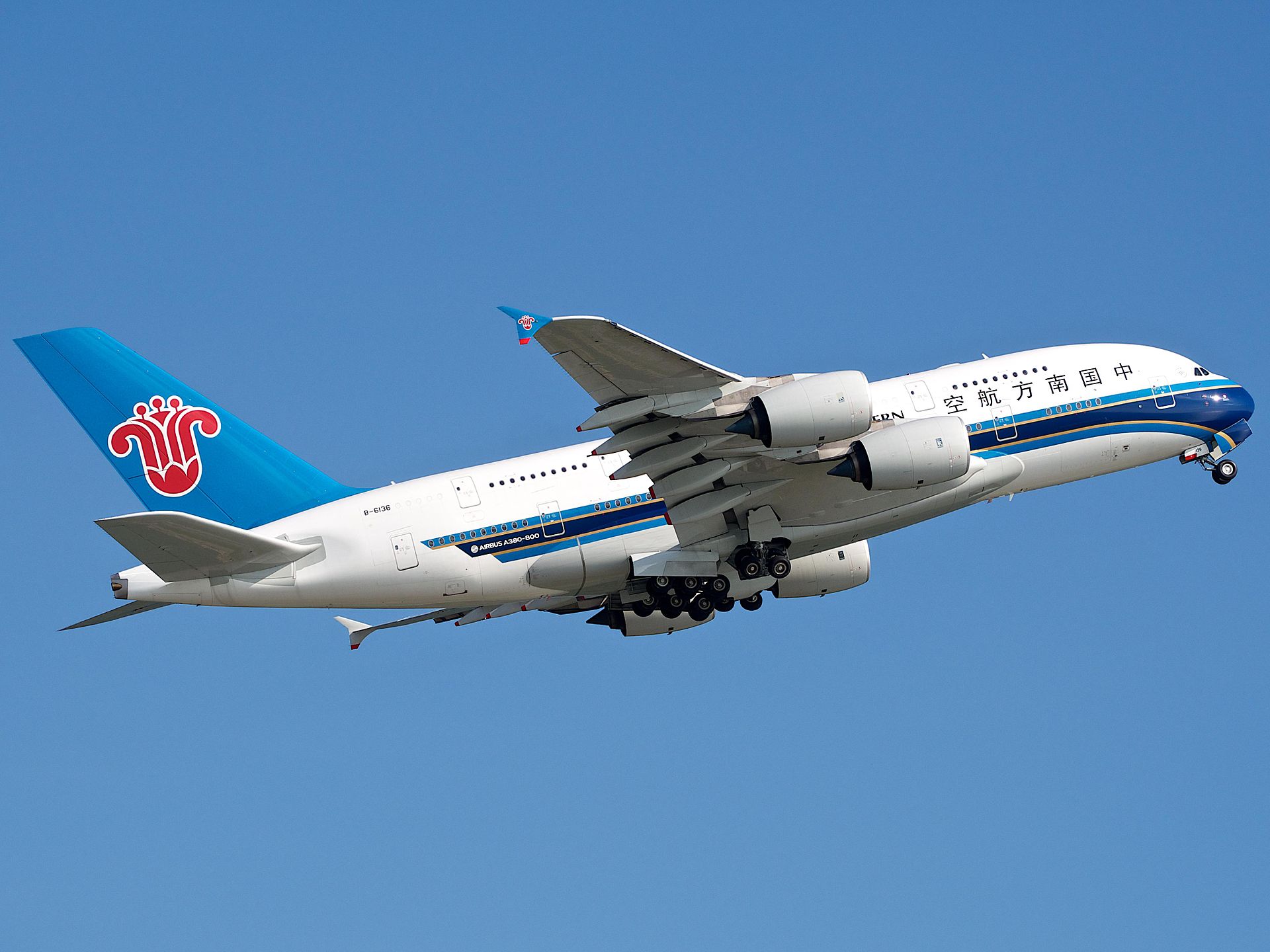
im_64 = img2base64('./assets/airplane.jpeg')
# First round chat
msgs = [{"role": "user", "content": "Tell me the model of this aircraft."}]
inputs = {"image": im_64, "question": json.dumps(msgs)}
answer = chat_model.chat(inputs)
print(answer)
# Second round chat
# pass history context of multi-turn conversation
msgs.append({"role": "assistant", "content": answer})
msgs.append({"role": "user", "content": "Introduce something about Airbus A380."})
inputs = {"image": im_64, "question": json.dumps(msgs)}
answer = chat_model.chat(inputs)
print(answer)
```
You will get the following output:
```
"The aircraft in the image is an Airbus A380, which can be identified by its large size, double-deck structure, and the distinctive shape of its wings and engines. The A380 is a wide-body aircraft known for being the world's largest passenger airliner, designed for long-haul flights. It has four engines, which are characteristic of large commercial aircraft. The registration number on the aircraft can also provide specific information about the model if looked up in an aviation database."
"The Airbus A380 is a double-deck, wide-body, four-engine jet airliner made by Airbus. It is the world's largest passenger airliner and is known for its long-haul capabilities. The aircraft was developed to improve efficiency and comfort for passengers traveling over long distances. It has two full-length passenger decks, which can accommodate more passengers than a typical single-aisle airplane. The A380 has been operated by airlines such as Lufthansa, Singapore Airlines, and Emirates, among others. It is widely recognized for its unique design and significant impact on the aviation industry."
```
### Inference on Mac
Click to view an example, to run MiniCPM-Llama3-V 2.5 on 💻 Mac with MPS (Apple silicon or AMD GPUs).
```python
# test.py Need more than 16GB memory.
import torch
from PIL import Image
from transformers import AutoModel, AutoTokenizer
model = AutoModel.from_pretrained('openbmb/MiniCPM-Llama3-V-2_5', trust_remote_code=True, low_cpu_mem_usage=True)
model = model.to(device='mps')
tokenizer = AutoTokenizer.from_pretrained('openbmb/MiniCPM-Llama3-V-2_5', trust_remote_code=True)
model.eval()
image = Image.open('./assets/hk_OCR.jpg').convert('RGB')
question = 'Where is this photo taken?'
msgs = [{'role': 'user', 'content': question}]
answer, context, _ = model.chat(
image=image,
msgs=msgs,
context=None,
tokenizer=tokenizer,
sampling=True
)
print(answer)
```
Run with command:
```shell
PYTORCH_ENABLE_MPS_FALLBACK=1 python test.py
```
### Deployment on Mobile Phone
MiniCPM-V 2.0 can be deployed on mobile phones with Android operating systems. 🚀 Click [here](https://github.com/OpenBMB/mlc-MiniCPM) to install apk. MiniCPM-Llama3-V 2.5 coming soon.
### WebUI Demo
Click to see how to deploy WebUI demo on different devices
```shell
pip install -r requirements.txt
```
```shell
# For NVIDIA GPUs, run:
python web_demo_2.5.py --device cuda
# For Mac with MPS (Apple silicon or AMD GPUs), run:
PYTORCH_ENABLE_MPS_FALLBACK=1 python web_demo_2.5.py --device mps
```
### Inference with vLLM
Click to see how to inference with vLLM
Because our pull request to vLLM is still waiting for reviewing, we fork this repository to build and test our vLLM demo. Here are the steps:
1. Clone our version of vLLM:
```shell
git clone https://github.com/OpenBMB/vllm.git
```
2. Install vLLM:
```shell
cd vllm
pip install -e .
```
3. Install timm:
```shell
pip install timm=0.9.10
```
4. Run our demo:
```shell
python examples/minicpmv_example.py
```
## Fine-tuning
### Simple Fine-tuning
We support simple fine-tuning with Hugging Face for MiniCPM-V 2.0 and MiniCPM-Llama3-V 2.5.
[Reference Document](./finetune/readme.md)
### With the SWIFT Framework
We now support MiniCPM-V series fine-tuning with the SWIFT framework. SWIFT supports training, inference, evaluation and deployment of nearly 200 LLMs and MLLMs . It supports the lightweight training solutions provided by PEFT and a complete Adapters Library including techniques such as NEFTune, LoRA+ and LLaMA-PRO.
Best Practices:[MiniCPM-V 1.0](https://github.com/modelscope/swift/blob/main/docs/source/Multi-Modal/minicpm-v最佳实践.md), [MiniCPM-V 2.0](https://github.com/modelscope/swift/blob/main/docs/source/Multi-Modal/minicpm-v-2最佳实践.md)
## TODO
- [x] MiniCPM-V fine-tuning support
- [ ] Code release for real-time interactive assistant
## Model License
The code in this repo is released according to [Apache-2.0](https://github.com/OpenBMB/MiniCPM/blob/main/LICENSE)
The usage of MiniCPM-V's and OmniLMM's parameters is subject to "[General Model License Agreement - Source Notes - Publicity Restrictions - Commercial License](https://github.com/OpenBMB/General-Model-License/blob/main/通用模型许可协议-来源说明-宣传限制-商业授权.md)"
The parameters are fully open to academic research
Please contact cpm@modelbest.cn to obtain written authorization for commercial uses. Free commercial use is also allowed after registration.
## Statement
As LMMs, MiniCPM-V models (including OmniLMM) generate contents by learning a large amount of multimodal corpora, but they cannot comprehend, express personal opinions or make value judgement. Anything generated by MiniCPM-V models does not represent the views and positions of the model developers
We will not be liable for any problems arising from the use of MiniCPMV-V models, including but not limited to data security issues, risk of public opinion, or any risks and problems arising from the misdirection, misuse, dissemination or misuse of the model.
## Institutions
This project is developed by the following institutions:
-  [THUNLP](https://nlp.csai.tsinghua.edu.cn/)
-
[THUNLP](https://nlp.csai.tsinghua.edu.cn/)
-  [ModelBest](https://modelbest.cn/)
-
[ModelBest](https://modelbest.cn/)
-  [Zhihu](https://www.zhihu.com/ )
## Other Multimodal Projects from Our Team
👏 Welcome to explore other multimodal projects of our team:
[VisCPM](https://github.com/OpenBMB/VisCPM/tree/main) | [RLHF-V](https://github.com/RLHF-V/RLHF-V) | [LLaVA-UHD](https://github.com/thunlp/LLaVA-UHD) | [RLAIF-V](https://github.com/RLHF-V/RLAIF-V)
## Citation
If you find your model/code/paper helpful, please consider cite the following papers:
```bib
@article{yu2023rlhf,
title={Rlhf-v: Towards trustworthy mllms via behavior alignment from fine-grained correctional human feedback},
author={Yu, Tianyu and Yao, Yuan and Zhang, Haoye and He, Taiwen and Han, Yifeng and Cui, Ganqu and Hu, Jinyi and Liu, Zhiyuan and Zheng, Hai-Tao and Sun, Maosong and others},
journal={arXiv preprint arXiv:2312.00849},
year={2023}
}
@article{viscpm,
title={Large Multilingual Models Pivot Zero-Shot Multimodal Learning across Languages},
author={Jinyi Hu and Yuan Yao and Chongyi Wang and Shan Wang and Yinxu Pan and Qianyu Chen and Tianyu Yu and Hanghao Wu and Yue Zhao and Haoye Zhang and Xu Han and Yankai Lin and Jiao Xue and Dahai Li and Zhiyuan Liu and Maosong Sun},
journal={arXiv preprint arXiv:2308.12038},
year={2023}
}
@article{xu2024llava-uhd,
title={{LLaVA-UHD}: an LMM Perceiving Any Aspect Ratio and High-Resolution Images},
author={Xu, Ruyi and Yao, Yuan and Guo, Zonghao and Cui, Junbo and Ni, Zanlin and Ge, Chunjiang and Chua, Tat-Seng and Liu, Zhiyuan and Huang, Gao},
journal={arXiv preprint arXiv:2403.11703},
year={2024}
}
```
[Zhihu](https://www.zhihu.com/ )
## Other Multimodal Projects from Our Team
👏 Welcome to explore other multimodal projects of our team:
[VisCPM](https://github.com/OpenBMB/VisCPM/tree/main) | [RLHF-V](https://github.com/RLHF-V/RLHF-V) | [LLaVA-UHD](https://github.com/thunlp/LLaVA-UHD) | [RLAIF-V](https://github.com/RLHF-V/RLAIF-V)
## Citation
If you find your model/code/paper helpful, please consider cite the following papers:
```bib
@article{yu2023rlhf,
title={Rlhf-v: Towards trustworthy mllms via behavior alignment from fine-grained correctional human feedback},
author={Yu, Tianyu and Yao, Yuan and Zhang, Haoye and He, Taiwen and Han, Yifeng and Cui, Ganqu and Hu, Jinyi and Liu, Zhiyuan and Zheng, Hai-Tao and Sun, Maosong and others},
journal={arXiv preprint arXiv:2312.00849},
year={2023}
}
@article{viscpm,
title={Large Multilingual Models Pivot Zero-Shot Multimodal Learning across Languages},
author={Jinyi Hu and Yuan Yao and Chongyi Wang and Shan Wang and Yinxu Pan and Qianyu Chen and Tianyu Yu and Hanghao Wu and Yue Zhao and Haoye Zhang and Xu Han and Yankai Lin and Jiao Xue and Dahai Li and Zhiyuan Liu and Maosong Sun},
journal={arXiv preprint arXiv:2308.12038},
year={2023}
}
@article{xu2024llava-uhd,
title={{LLaVA-UHD}: an LMM Perceiving Any Aspect Ratio and High-Resolution Images},
author={Xu, Ruyi and Yao, Yuan and Guo, Zonghao and Cui, Junbo and Ni, Zanlin and Ge, Chunjiang and Chua, Tat-Seng and Liu, Zhiyuan and Huang, Gao},
journal={arXiv preprint arXiv:2403.11703},
year={2024}
}
```


